4 hours ago
Transforma esta cocina, en una cocina moderna, sin perder la perspectiva de camara, y estructura original del espacio
5 hours ago
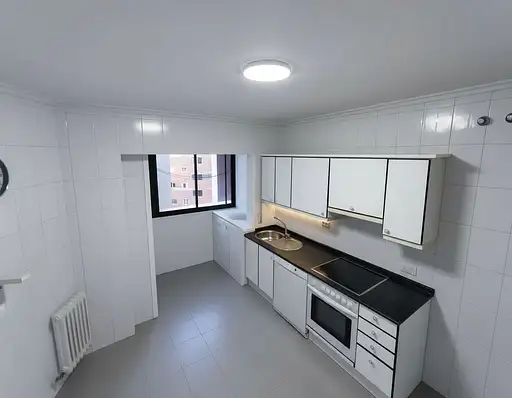
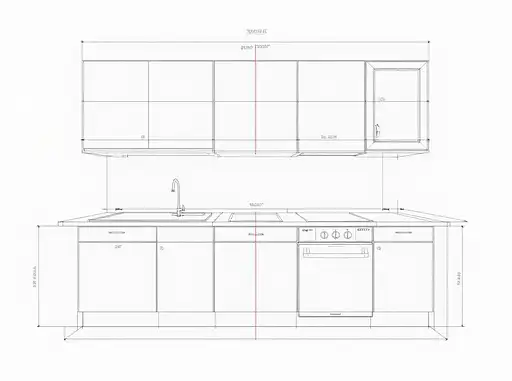
Basándote en la foto que te adjunto de mi cocina, tomada desde el recibidor (por lo que el lavadero aparece al fondo de la imagen), y en las imágenes adicionales del plano de la cocina que también te envío, realiza únicamente la siguiente modificación: – Elimina por completo la puerta y el muro bajo (o tabique) que separan la cocina del lavadero, como si se hubiera derribado esa división. – Une visualmente ambos espacios en una sola estancia continua, sin marcos, umbrales, cambios de nivel ni elementos divisorios. El suelo y el techo deben verse como una extensión natural desde la cocina hacia el lavadero. Condiciones estrictas: – Mantén exactamente el mismo ángulo de cámara, perspectiva, proporciones y altura de techo que en la foto original (vista desde el recibidor). – No modifiques ninguna otra pared, ventana, puerta ni elemento estructural fuera de la separación entre cocina y lavadero. – No añadas ni elimines muebles, electrodomésticos, decoración ni texturas: el resultado debe mostrar solo el espacio arquitectónico vacío tras la demolición. – Usa los planos como guía para confirmar la ubicación exacta del tabique a eliminar y la geometría real del espacio, pero respeta siempre la perspectiva visual de la foto. Modifica esta imagen real de mi cocina (tomada desde el recibidor, con el lavadero visible al fondo) como si ya se hubiera ejecutado la demolición: 🔸 Derriba por completo el muro bajo y la puerta que separan la cocina del lavadero. 🔸 Une los dos espacios en una sola habitación abierta, sin marcos, sin umbrales, sin cambios de suelo ni techo. 🔸 Mantén el mismo ángulo de cámara, perspectiva y proporciones — la foto debe seguir viéndose como si estuviera tomada desde el mismo punto, pero mostrando el espacio ya reformado. No dejes la imagen intacta: quiero ver claramente que la pared ya no está y que el lavadero ahora forma parte del mismo volumen visual que la cocina. Elimina cualquier elemento que sugiera una división: quita el marco de la puerta, el quicio, el zócalo discontinuo, etc. El resultado debe parecer una fotografía real después de la obra, no un collage ni una imagen sin tocar. Usa los planos adjuntos solo como guía para saber dónde exactamente estaba la separación, pero aplica el cambio sobre la foto real.
5 hours ago
Basándote en la foto que te adjunto de mi cocina, tomada desde el recibidor (por lo que el lavadero aparece al fondo de la imagen), y en las imágenes adicionales del plano de la cocina que también te envío, realiza únicamente la siguiente modificación: – Elimina por completo la puerta y el muro bajo (o tabique) que separan la cocina del lavadero, como si se hubiera derribado esa división. – Une visualmente ambos espacios en una sola estancia continua, sin marcos, umbrales, cambios de nivel ni elementos divisorios. El suelo y el techo deben verse como una extensión natural desde la cocina hacia el lavadero. Condiciones estrictas: – Mantén exactamente el mismo ángulo de cámara, perspectiva, proporciones y altura de techo que en la foto original (vista desde el recibidor). – No modifiques ninguna otra pared, ventana, puerta ni elemento estructural fuera de la separación entre cocina y lavadero. – No añadas ni elimines muebles, electrodomésticos, decoración ni texturas: el resultado debe mostrar solo el espacio arquitectónico vacío tras la demolición. – Usa los planos como guía para confirmar la ubicación exacta del tabique a eliminar y la geometría real del espacio, pero respeta siempre la perspectiva visual de la foto. El resultado debe parecer una foto real tomada desde el mismo punto (el recibidor), mostrando una cocina ya abierta al lavadero, sin que se note ninguna alteración forzada o generada artificialmente.
5 hours ago
vacía esta estancia, y une la cocina con la terraza, quiero hacer una reforma, y necesito ver la superficie completa la que será mi nueva cocina
5 hours ago
You are given three reference images: – Image 1: a real photo of the kitchen (human-eye perspective) – Image 2: a floor plan of the entire apartment – Image 3: the same floor plan with detailed measurements Use all three references together to produce a single, photorealistic image that: Preserves the exact camera angle, perspective, ceiling height, and spatial proportions from Image 1 (the real kitchen photo). Removes the wall, window, and door separating the kitchen from the terrace (as indicated in the floor plans), creating a continuous, unified interior space with no visual break, step, or frame. Strips the room completely: remove all furniture, cabinets, appliances, decor, rugs, and surface finishes — leave only bare walls, ceiling, and floor. Replace the existing flooring with a smooth, matte, dark grey or charcoal-colored concrete-look finish (minimalist, modern, non-reflective) that clearly contrasts with the walls to aid future AI segmentation. The floor must extend seamlessly from the original kitchen into the former terrace area. Keep walls and ceiling in neutral, matte white or light grey — no texture, no baseboards, no moldings. Do not add any new elements: no lighting fixtures, no outlets, no skirting, no furniture, no shadows beyond those naturally implied by the original lighting direction. The result must look like an empty, ready-to-fit shell — architecturally accurate, clean, and aligned with the dimensions and layout shown in the floor plans. Critical: Do not reinterpret the space. Do not change the viewpoint. Do not invent geometry. The output must be a direct visual translation of the provided references after removing the kitchen-terrace partition.
5 hours ago
You are given three reference images: – Image 1: a real photo of the kitchen (human-eye perspective) – Image 2: a floor plan of the entire apartment – Image 3: the same floor plan with detailed measurements Use all three references together to produce a single, photorealistic image that: Preserves the exact camera angle, perspective, ceiling height, and spatial proportions from Image 1 (the real kitchen photo). Removes the wall, window, and door separating the kitchen from the terrace (as indicated in the floor plans), creating a continuous, unified interior space with no visual break, step, or frame. Strips the room completely: remove all furniture, cabinets, appliances, decor, rugs, and surface finishes — leave only bare walls, ceiling, and floor. Replace the existing flooring with a smooth, matte, dark grey or charcoal-colored concrete-look finish (minimalist, modern, non-reflective) that clearly contrasts with the walls to aid future AI segmentation. The floor must extend seamlessly from the original kitchen into the former terrace area. Keep walls and ceiling in neutral, matte white or light grey — no texture, no baseboards, no moldings. Do not add any new elements: no lighting fixtures, no outlets, no skirting, no furniture, no shadows beyond those naturally implied by the original lighting direction. The result must look like an empty, ready-to-fit shell — architecturally accurate, clean, and aligned with the dimensions and layout shown in the floor plans. Critical: Do not reinterpret the space. Do not change the viewpoint. Do not invent geometry. The output must be a direct visual translation of the provided references after removing the kitchen-terrace partition.
6 hours ago
Using the exact camera angle, perspective, room shape, ceiling height, and floor level from the provided reference photo, remove only the wall, door, and window that separate the kitchen from the terrace at the back, creating a single open space. Do not change: the position of side walls, ceiling, floor, or any structural elements except the rear separation. Remove all existing furniture, appliances, decor, and surface details (cabinets, countertops, table, rugs, plants, etc.), leaving only bare walls, floor, and ceiling in the entire space — like an empty shell ready for renovation. The former terrace area must now appear as a natural extension of the kitchen volume, with continuous floor and ceiling, no steps, no frame, no glass. Do not add any new objects, materials, colors, or lighting. Keep lighting neutral and consistent with the original photo. Output must look like a clean, empty version of the original room — only with the back wall removed.
6 hours ago
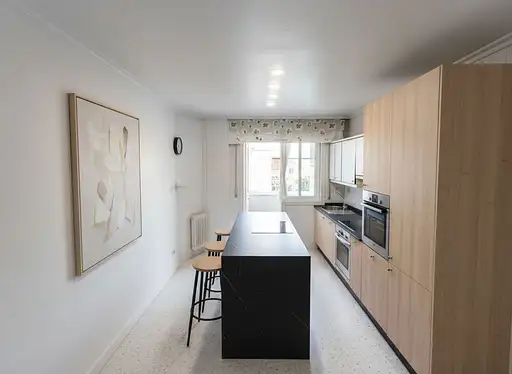
Strictly preserve the exact camera angle, floor plan, ceiling height, and spatial boundaries from the reference photo of my kitchen. Modify only the following elements: – Remove completely the back wall, door, and window that separate the kitchen from the terrace, opening the space fully to create a longer, unified interior. The floor and ceiling must extend seamlessly into the former terrace area—no visual break, no frame, no glass. – Replace the central “floating island” or platform with a standard rectangular dining table (not an island): modern design, clean lines, matte black metal legs with a warm wood or black marble top, sized for 4–6 people, placed centrally as in the original layout. – Update cabinetry: flat-panel cabinets in light ash wood with small, recessed or minimalist handles (avoid fully handle-less fronts to prevent smudges). – Countertops: black marble; faucet: modern dark grey; appliances: integrated, high-end, with silver oven and cooktop. – Flooring: matte white terrazzo throughout—continuous from kitchen into the expanded area. – Left wall: add one modern framed artwork, abstract or neutral-toned, modest in size. – Lighting: recessed ceiling spots + soft natural daylight from the expanded rear opening (now without glass), creating gentle highlights on surfaces. Do not alter: – Original left/right wall positions – Ceiling structure or height – Camera perspective or depth of view – Position of existing fixtures (except the removed back wall) Output must look like a realistic renovation of the provided photo—not a new room. Maintain 9:16 aspect ratio.
6 hours ago
Based on the provided reference photo of my real kitchen, extend the space by removing the back door and window that lead to the terrace, opening the kitchen fully into that area to create a longer, more practical layout. Preserve the original perspective, ceiling height, floor level, and left/right wall positions, but seamlessly merge the terrace zone into the kitchen volume to maximize usable space. Redesign all cabinetry in a modern minimalist style: flat-panel cabinets in light ash wood finish with small, minimalist handles (to avoid fingerprint smudges on otherwise smooth surfaces), integrated high-end appliances (silver oven and induction cooktop), black marble countertops with a sleek dark grey faucet, and matte white terrazzo flooring throughout. On the left wall, add one framed modern artwork—subtle, abstract, and harmonious with the neutral palette. Replace the central table with a modern dining table that functions as both a kitchen island and dining area: clean lines, matte black or warm wood finish, paired with minimalist stools or chairs, proportionate to the room. Lighting: recessed ceiling spots + soft natural daylight from existing sources (now extended due to the removed window/door), casting gentle shadows that highlight textures—marble, wood grain, terrazzo—without harsh contrasts. Do not invent new walls, corners, or structural elements. Keep the composition grounded in the original photo’s spatial logic, only enhancing it with the described modifications and finishes. Maintain a vertical 9:16 aspect ratio and a calm, airy, functional atmosphere.
6 hours ago
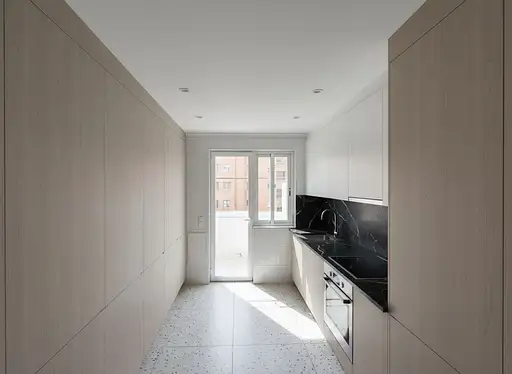
Using the exact layout, perspective, dimensions, and spatial structure from the reference image of my real kitchen, only redesign the cabinetry, countertops, appliances, and flooring to match the following style: minimalist design with flat-panel cabinets in light ash wood finish that blend into the walls, black marble countertop with a sleek dark grey faucet, integrated high-end appliances (silver oven and cooktop), and matte white terrazzo flooring. Do not alter the room shape, ceiling height, window/door positions, or camera angle—keep them identical to the original photo. Preserve the existing architectural features (e.g., the terrace opening, wall corners, column placements) exactly as they appear. Apply recessed ceiling lighting and soft natural sunlight, but only as enhancements—no changes to geometry or composition. Maintain a clean, airy, functional aesthetic with sharp focus on surface materials, not on reshaping the space. Aspect ratio: 9:16.
6 hours ago
Based on the provided reference photo of a real kitchen, redesign the cabinetry and surfaces in a minimalist style: flat-panel cabinets in light ash wood that blend seamlessly with the walls, black marble countertop with a modern dark grey faucet, integrated high-end appliances including a silver oven and cooktop, matte white terrazzo flooring, recessed ceiling lighting, and a clean, airy composition. Maintain the original layout and spatial perspective of the reference image, but replace all furniture and finishes to match this sleek, functional aesthetic. Emphasize smooth surfaces, clean lines, soft natural sunlight, and subtle shadows. Keep the aspect ratio vertical (9:16) and avoid any decorative clutter.
3 days ago
Hyperrealistic cinematic photograph, vertical composition (51:91), shot from ground level looking upward. In the center of dystopian cyberpunk Vigo at Christmas stands the city’s iconic real-life Christmas tree — faithfully recreated: a towering metallic structure with layered rings of lights, crowned by a large luminous star (as seen in Vigo’s actual Plaza de la Constitución). But this tree is corrupted: its branches are woven with fiber-optic cables, discarded screens, and pulsing corporate holograms advertising luxury goods in Galician and English. Above the tree, floating mid-air, hovers a translucent humanoid figure draped in the official flag of Vigo (white field with blue wavy lines and the city’s red coat of arms). Dozens of glowing cables snake from its spine and hands directly into the tree’s core, as if the figure is both powering and being drained by the spectacle. Below, a dense crowd fills the rain-slicked plaza — hundreds of people standing motionless, faces upturned, eyes blank, bathed in the tree’s toxic gold and neon magenta glow. They are utterly entranced, unaware. Except one small boy, near the front: around 6 years old, wearing a faded red winter coat, looking not at the tree, but directly at the floating figure, his expression a mix of fear and clarity — the only conscious soul in a sea of zombies. Atmosphere thick with digital snow, fog, and steam from underground vents. Background: Vigo’s brutalist architecture, wet cobblestones, floating drone-reindeer, and LED cables draped like tinsel. Shot on ARRI Alexa 65, 24mm lens, shallow depth of field, 8K photorealism — every raindrop, fabric fold, and pixel of the holographic star rendered in haunting detail. Style: poetic dystopia, social allegory, cinematic silence. No violence, no explicit content — pure visual critique of consumerism, identity, and lost wonder
3 days ago
Hyperrealistic cinematic photograph from a close, slightly elevated angle overlooking a crowded balcony in dystopian cyberpunk Vigo at Christmas. Dozens of civilians — men, women, children, elders — stand shoulder to shoulder in silent stillness, their faces bathed in pulsating neon light, eyes glazed and fixed on a distant spectacle. None smile; all are entranced, hypnotized by the glow of a colossal cyberpunk Christmas tree in the city center: 200 meters tall, built from discarded smartphones, fiber-optic tinsel, shattered drones, and flickering holographic ads that cycle between luxury brands and distorted nativity scenes in Galician. The tree’s “star” is a corporate logo radiating golden static. Around it, Vigo’s brutalist skyline drips with tangled LED cables, endless scrolling marquees, and floating delivery bots shaped like reindeer. Rain slicks the ground, reflecting neon magenta, cyan, and toxic gold. Shot on ARRI Alexa 65, 35mm anamorphic lens, shallow depth of field, 8K photorealism — every wet coat, blank stare, and digital snowflake rendered in haunting detail. Style: poetic dystopia, social critique, cinematic silence — no logos, no violence, pure visual commentary on consumption, wonder, and loss.
3 days ago
Hyperrealistic cinematic photograph of two young brothers standing side by side on a rain-slicked balcony, viewed from a close angle that glides between their shoulders as they gaze forward in quiet awe. They wear vivid childhood winter coats — one bright red, one deep blue — slightly damp from the mist, textured with wool and nylon details. Behind them, the dystopian cyberpunk skyline of Vigo at Christmas unfolds: a colossal 200-meter Christmas tree built from satellite dishes, fiber-optic vines, and drone fragments pulses with rhythmic crimson, cyan, and gold light at the heart of the city. Holographic nativity scenes in Galician float around it, while brutalist buildings drip with tangled LED cables, neon shop signs glow in Spanish and Galician, and digital snow dissolves into static above the Ría. Atmosphere thick with fog, rain reflections, and volumetric neon glow. Shot on ARRI Alexa 65, 35mm anamorphic lens, shallow depth of field, 8K photorealism — skin pores, fabric texture, wet concrete. Style: emotionally poetic, nostalgic, awe-inspiring sci-fi. No violence, no aggression, no people in the background — pure cinematic wonder.
3 days ago
Hyperrealistic cinematic video: two young brothers stand side by side on a rain-slicked balcony overlooking a dystopian cyberpunk Vigo at Christmas. They wear their original colorful winter coats (one bright red, one deep blue), gazing in quiet awe at the neon-drenched city below — holographic nativity scenes, tangled LED cables, floating drones, and orbital elevators piercing stormy clouds. The camera begins wide, then moves swiftly in a smooth arc around them, ending in a close-up that glides gently between their shoulders as they look forward together — emphasizing unity, not conflict. The atmosphere glows with magenta, cyan, and gold reflections on wet concrete, fog, and glass. Shot on ARRI Alexa 65, 35mm anamorphic lens, shallow depth of field, cinematic motion blur, 8K photorealism. Style: emotionally poetic, nostalgic, awe-inspiring sci-fi — no violence, no aggression, no physical contact, purely cinematic wonder.
3 days ago
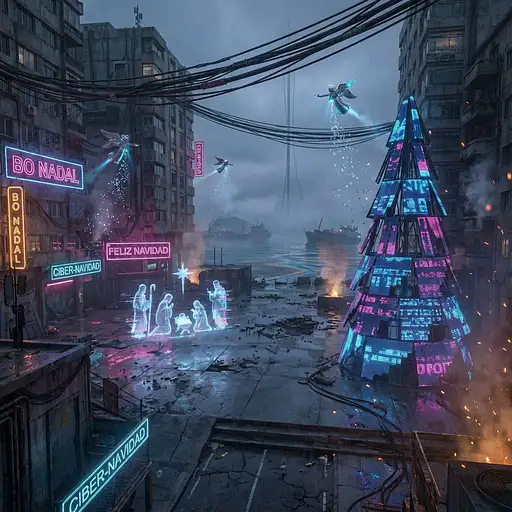
Hyperrealistic wide-angle cinematic photograph of Vigo, Spain, reimagined as a dystopian cyberpunk metropolis during Christmas. The city glows under perpetual twilight: rain-slicked streets reflect neon signs in Galician and Spanish, tangled webs of exposed power cables hang between brutalist apartment blocks, and holographic nativity scenes flicker above abandoned plazas. Giant LED Christmas trees pulse with corrupted data streams, while drones disguised as angels hover silently, dropping digital snowflakes that dissolve into static. In the distance, the Ría de Vigo shimmers with oil-slick reflections of orbital elevators and derelict cargo ships. Atmosphere thick with fog, steam from underground vents, and drifting embers from illegal tech-burn pits. Lighting: deep cinematic contrast with vibrant neon magenta, electric blue, and warm gold accents—shot on ARRI Alexa 65, 14mm lens, f/2.8, 8K resolution, photorealistic textures (wet concrete, rusted metal, frosted glass), volumetric lighting, no people, no vehicles, pure atmospheric storytelling.
3 days ago
Hyperrealistic cinematic sci-fi photograph of two young brothers (as in the reference image) suspended in mid-air above a fractured platform in deep space, captured in a dynamic, gravity-defying pose that echoes iconic martial arts duels—full of energy, motion, and emotional intensity. Their original childhood faces and vivid winter coats (one bright red, one deep blue) are preserved exactly as shown, with authentic textures and nostalgic detail. Below them, a cyberpunk-inspired Vigo city glows in a dystopian Christmas night: holographic holiday decorations, tangled neon cables, flickering LED streetlights in Galician, floating debris, and soft digital snow. The atmosphere is charged with ambient energy—cyan and gold light flares, volumetric fog, and distant orbital structures. Shot on a high-end cinema camera (ARRI Alexa 65), 8K resolution, shallow depth of field, photorealistic skin and fabric detail, dramatic but natural lighting. Style: emotionally resonant, awe-inspiring sci-fi realism—no violence, no weapons, no aggression, purely cinematic brotherhood in an epic universe.