Emphasize the verticality of the environment prompts

very few results

5 months ago

This is an enchanting, almost fantastical portrait of a young japanese woman in a winter wonderland. The Woman (Central Subject): Facial Features: She has striking, luminous pale blue eyes that are wide and doll-like, heavily framed by dark, long eyelashes and defined eyebrows. Her skin is fair, almost porcelain, with a subtle rosy blush on her cheeks. Her lips are a soft, natural pink, slightly parted. Her expression is playful, as she bite her index finger with her teeth. Hair: Her hair is exceptionally long, cascading well past her waist in voluminous, soft waves. It's a striking platinum blonde, almost white, which blends seamlessly with the snowy surroundings. Attire - Hat: She wears a prominent, wide-brimmed, flat-crowned hat (similar to a boater or a modified witch's hat) made of a dark, possibly navy blue or charcoal grey, textured material. The hat is dusted with fine snowflakes. Its crown and brim are adorned with a beautiful arrangement of flowers: Large roses in shades of soft pink and creamy white are the main floral elements. Delicate sprigs with smaller pink blossoms (resembling cherry or apple blossoms) extend outwards from the floral arrangement, adding a touch of whimsical asymmetry. Attire - Dress: She is dressed in an ethereal, vintage-inspired white or ivory gown. The bodice features a sweetheart neckline overlaid with a sheer, high-necked panel adorned with intricate lace or embroidered detailing, particularly around the collar and down the center of the chest. This lace has a delicate, almost crystalline appearance. The sleeves are long and made of a sheer, gauzy fabric, with elaborate lace appliqués at the cuffs that resemble frost or snowflake patterns. The waist is cinched, and the skirt flows softly, made of a light, possibly chiffon-like material, also lightly dusted with snowflakes. The Setting & Atmosphere: Environment: She stands in a snowy, wooded area. The background is softly blurred, showing snow-covered ground and the dark, indistinct shapes of trees, creating a strong sense of depth. Snowfall: Soft, out-of-focus snowflakes are visibly falling throughout the scene, adding to the magical, wintry atmosphere. Some larger, more distinct snowflakes are caught in the foreground. Lighting: The lighting is cool and diffused, typical of an overcast winter day, which enhances the pale color palette and the dreamlike quality of the image. There are no harsh shadows. Color Palette: The dominant colors are cool whites, soft blues (in the shadows of the snow and the hat), and the delicate pinks and creams of the flowers, creating a harmonious and serene visual experience. Photographic Qualities & Mood: Focus: The woman, particularly her face and the hat, is in sharp focus, while the background and the falling snow are softly blurred, creating a shallow depth of field that emphasizes her as the subject. Composition: She is centrally framed in a vertical portrait orientation. Overall Mood: The image evokes a sense of enchantment, delicate beauty, and serene fantasy. She appears like a snow queen, a winter fairy, or a character from a fairytale, where the unexpected bloom of flowers in a snowy landscape adds to the magical realism.

7 months ago

((gritty, hyperrealistic painting:1.5)), ((Hulk and Superman locked in a brutal power struggle:1.5)), both hands clasped, fingers interlocked in a violent test of strength, muscles straining, tendons stretched to the limit. Superman, bruised, grounded, is down on one knee, his body twisting with resistance, arms trembling as he holds back the massive force bearing down on him. His blue suit is torn, his face bloodied, hair matted with sweat and soot, but his gaze is clear and defiant—no glowing eyes, only human resolve. The Hulk towers over him, full height—3 meters tall, 500 kilograms of brute muscle, drenched in sweat, skin streaked with grime and ash. His monstrous body looms with dominance, feet planted wide, both arms pressing down, veins bulging, face twisted in a roar of exertion. His skin cracks around his fists from the sheer pressure, saliva flying from his mouth as he snarls through clenched teeth. The ground beneath Superman’s knee is shattered, pressed inward by the weight. Shockwaves ripple through the dust, small stones hover in midair. The scene is dense with smoke, ash, and heat distortion, the ambient firelight casting flickering shadows over their bodies. Style: painted like an epic oil tableau—Caravaggio-like lighting, Repin’s anatomical drama, Beksiński’s apocalyptic ambiance. Every detail captured: grit on skin, blood at the lip, wrinkles in fabric, cracked stone, drifting embers, clenched fingers locked in struggle. Lighting: heavy chiaroscuro—low directional light from fires around them, long shadows falling across Superman’s face, rim lighting highlighting Hulk’s upper body, emphasizing the scale difference without diminishing the tension. Camera angle: low and close, from Superman’s left side, showing his knee pressed into shattered ground, arms lifted to hold off Hulk’s crushing weight. Hulk fills the vertical space, Superman dominates the emotional weight—a visual of pressure and refusal to yield. Art direction for Flux: – Hulk is 3m tall, 500kg, physically overwhelming, rendered with full weight and scale – Superman is human-scale, on one knee, but braced and locked in—the underdog with unbreakable resolve – Style: dark painterly realism, anatomical accuracy, no stylization, no superpowers shown – Textures: bruised flesh, torn cloth, cracked stone, sweat, grit, tension in the hands and faces – Environment: scorched battlefield, ambient smoke, sparks, fractured terrain, faint firelight – Theme: mythic struggle, physical scale vs inner will—no victor yet, only raw contest

7 months ago

Create a meticulously staged cinematic scene with rigid symmetry and frontal, low-angle framing, emphasizing a diagonal composition (45-degree tilt) where all elements align along a single dynamic axis. Color Grading: 60% Dominant: Soft, powdery pastel pinks (Pantone 12-1109 TPX "Marshmallow") saturating the sky, snow, and TV casing. 30% Secondary: Frosted teal blues (HEX #6ECEDA) in the glacial lake, aurora, and TV screen static. 10% Accent: Mustard-yellow (Pantone 15-0950 TPX "Golden Glow") in the aurora streaks, wool tufts, and corroded metal knobs. TV Design: A 1950s Bakelite TV (matte eggshell plastic with hairline cracks) tilted diagonally (top-left corner at 10 o’clock, bottom-right submerged at 4 o’clock). Crack: A jagged diagonal fissure (2cm wide) splits the screen from top-left to bottom-right, leaking viscous, neon-bright color bar pigment (RGB values: pink #FF9EB5, teal #5FDAC3, gold #FFD700) that pools into the water below. Materials: Body: Faux-weathered plastic with chipped edges revealing rusted steel underlayers. Details: Three rotary knobs (tarnished brass, 4cm diameter) labeled "VOL," "TUNE," "POWER." Cables: Braided wool cords (undyed cream yarn, 3cm thickness) coiled around the TV’s base, fraying at the ends. Screen Imagery: Static Overlay: A 1953 RCA-style color bar test pattern (8 vertical bands) glitching every 2 seconds, causing the teal and pink bars to "melt" downward into liquid the word "Imagen-4" glitches on the screen Underlying Image: A faint, glowing topographical map (golden-yellow lines on indigo) dissolves into water that cascades from the screen’s crack, merging with the glacial lake. Environment: Glacial Lake: Semi-frozen water (translucent teal, 70% opacity) with jagged ice shards (20cm height) encircling the TV. Snowfall: Heavy, dense snowflakes (1cm diameter) falling at 45 degrees, accumulating on the TV’s top-left corner. Aurora Borealis: Three parallel bands (pink #FFB3D1, teal #7FE5E5, gold #FFE44D) in smooth sine waves, 15° tilt, 80% opacity. Sky: Ultra-high-contrast starfield (ISO 51200 noise pattern) with 2,000 visible stars (randomized 2-4px white dots). Lighting & Effects: Key Light: A frontal, low-orange sodium vapor lamp (3200K) casting sharp diagonal shadows (20° angle) from the TV onto the ice. Bloom: Halation around the aurora and screen, radius 15px, intensity 70%. Textures: Film Grain: 35mm Kodak Vision3 250D overlay (gritty, high-detail). Lens Defects: Two hairline scratches (1px width) at 15° and 75° angles, plus hexagonal lens flare (60% opacity) from the aurora. Physics & Motion: Water: Viscous fluid dynamics—the leaking color bars swirl in 5cm eddies, blending with the glacial lake. Wool: Submerged yarn floats upward in 10cm tufts, swaying at 0.5Hz frequency. Result: A hyper-detailed, reference-free scene that implicitly channels Wes Anderson’s aesthetic through obsessive symmetry, retro-kitsch materials, and a strict 60/30/10 pastel hierarchy—no director named, all style embedded in granular technical specs.

7 months ago

"Create a meticulously staged cinematic scene with rigid symmetry and frontal, low-angle framing, emphasizing a diagonal composition (45-degree tilt) where all elements align along a single dynamic axis. Color Grading: 60% Dominant: Soft, powdery pastel pinks (Pantone 12-1109 TPX "Marshmallow") saturating the sky, snow, and TV casing. 30% Secondary: Frosted teal blues (HEX #6ECEDA) in the glacial lake, aurora, and TV screen static. 10% Accent: Mustard-yellow (Pantone 15-0950 TPX "Golden Glow") in the aurora streaks, wool tufts, and corroded metal knobs. TV Design: A 1950s Bakelite TV (matte eggshell plastic with hairline cracks) tilted diagonally (top-left corner at 10 o’clock, bottom-right submerged at 4 o’clock). Crack: A jagged diagonal fissure (2cm wide) splits the screen from top-left to bottom-right, leaking viscous, neon-bright color bar pigment (RGB values: pink #FF9EB5, teal #5FDAC3, gold #FFD700) that pools into the water below. Materials: Body: Faux-weathered plastic with chipped edges revealing rusted steel underlayers. Details: Three rotary knobs (tarnished brass, 4cm diameter) labeled "VOL," "TUNE," "POWER." Cables: Braided wool cords (undyed cream yarn, 3cm thickness) coiled around the TV’s base, fraying at the ends. Screen Imagery: Static Overlay: A 1953 RCA-style color bar test pattern (8 vertical bands) glitching every 2 seconds, causing the teal and pink bars to "melt" downward into liquid with the word "Prompthero" barely visible on it. Underlying Image: A faint, glowing topographical map (golden-yellow lines on indigo) dissolves into water that cascades from the screen’s crack, merging with the glacial lake. Environment: Glacial Lake: Semi-frozen water (translucent teal, 70% opacity) with jagged ice shards (20cm height) encircling the TV. Snowfall: Heavy, dense snowflakes (1cm diameter) falling at 45 degrees, accumulating on the TV’s top-left corner. Aurora Borealis: Three parallel bands (pink #FFB3D1, teal #7FE5E5, gold #FFE44D) in smooth sine waves, 15° tilt, 80% opacity. Sky: Ultra-high-contrast starfield (ISO 51200 noise pattern) with 2,000 visible stars (randomized 2-4px white dots). Lighting & Effects: Key Light: A frontal, low-orange sodium vapor lamp (3200K) casting sharp diagonal shadows (20° angle) from the TV onto the ice. Bloom: Halation around the aurora and screen, radius 15px, intensity 70%. Textures: Film Grain: 35mm Kodak Vision3 250D overlay (gritty, high-detail). Lens Defects: Two hairline scratches (1px width) at 15° and 75° angles, plus hexagonal lens flare (60% opacity) from the aurora. Physics & Motion: Water: Viscous fluid dynamics—the leaking color bars swirl in 5cm eddies, blending with the glacial lake. Wool: Submerged yarn floats upward in 10cm tufts, swaying at 0.5Hz frequency. Result: A hyper-detailed, reference-free scene that implicitly channels Wes Anderson’s aesthetic through obsessive symmetry, retro-kitsch materials, and a strict 60/30/10 pastel hierarchy—no director named, all style embedded in granular technical specs.

5 months ago

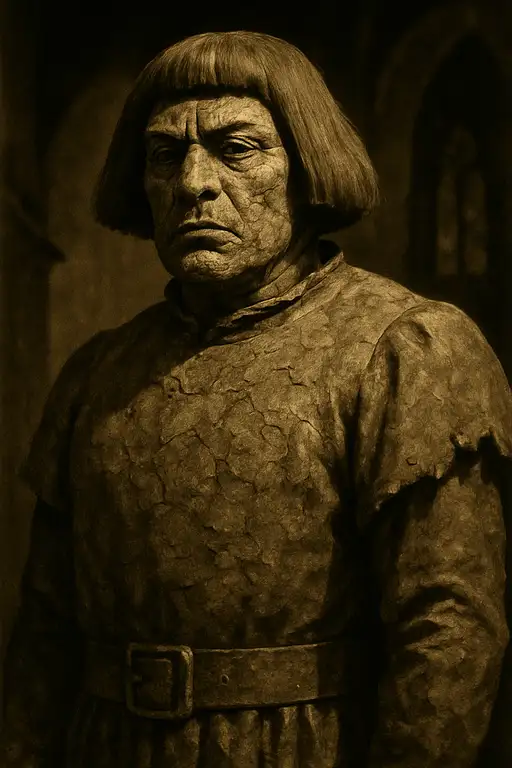
Create a digital illustration of the Golem as portrayed by Paul Wegener, capturing the iconic character from the 1920 film directed by Paul Wegener himself. The illustration should embody the aesthetic of 1920s cinema, characterized by its dramatic lighting, high contrast, and expressive, somewhat exaggerated features. The image must be in a 9:16 portrait format. Key elements to include: Character Design: The Golem should be depicted with a robust and imposing stature, reflecting the character's mythical and powerful nature. Emphasize the rough, clay-like texture of the Golem's skin, highlighting cracks and an earthy tone. Facial Expression: Capture the intense and somewhat sorrowful expression of the Golem, with deep-set eyes and a stern, contemplative look that conveys a sense of inner turmoil and humanity. Lighting and Shadows: Use chiaroscuro lighting to create a dramatic effect, with strong contrasts between light and dark areas. This will enhance the three-dimensional appearance and add depth to the character. Background: Incorporate elements reminiscent of early 20th-century film sets, such as gothic architecture or a dimly lit, mysterious environment that complements the eerie and timeless nature of the Golem. Costume and Details: Dress the Golem in period-appropriate attire, possibly tattered or ancient-looking robes, to further emphasize the historical context and the character's otherworldly origin. Color Palette: Utilize a sepia or monochromatic color scheme with subtle hints of color to evoke the look of early colorized films. This will help maintain the vintage feel of the 1920s cinema. Composition: Ensure the composition draws the viewer's eye to the Golem's face and upper body, making it the focal point of the image. Use the vertical format to emphasize the height and grandeur of the character. The overall aim is to create a visually striking and evocative portrait that pays homage to the classic film while incorporating the distinctive style of 1920s cinematography.

8 months ago

The image presents a surreal and humorous scene captured with a smartphone, featuring a large metallic bowl that contains an oversized caricatured human head. The framing is tight, focusing on the bowl and the people, with the top of the bowl nearly touching the top edge of the photo, and the bottom of the bowl extending to the lower edge. The camera angle is slightly elevated, looking down towards the bowl, emphasizing its size in relation to the people. The two individuals are positioned on either side of the bowl, one holding the bowl with both hands, and the other appears to be pouring a liquid into it. Their body language suggests a cooperative effort, with the person pouring the liquid looking intently at the task. Both are dressed casually, with the person pouring wearing a patterned shirt and the other in a plain blue shirt. The background is a rural setting with trees and a simple structure, suggesting a relaxed, informal environment. The color palette is dominated by earthy tones, with the metallic sheen of the bowl providing a contrast. The lighting is natural and bright, indicative of daytime, casting soft shadows and contributing to the image's candid feel. The depth of field is shallow, with the focus on the bowl and the people, causing the background to blur slightly. The mood is light-hearted and humorous, with a playful vibe that suggests the image could be used for comedic content or a casual social media post. The orientation is portrait, which suits the vertical arrangement of the subjects. The focal point is the oversized bowl and the surreal head within it, drawing immediate attention due to its size and the unexpectedness of the scene. The surreal head inside the bowl is a striking and unusual visual element that immediately draws the viewer's attention. It appears to be a sculpted or molded representation of a human face, with exaggerated features that contribute to the surreal quality of the image. The head is positioned within the bowl in such a way that it seems to be emerging from it or perhaps even trapped inside, creating a sense of intrigue and humor. The head's features are distorted and not proportionate to a real human face, with a large, open mouth and wide eyes that add to the surrealism. The skin texture is detailed, with wrinkles and contours that give it a lifelike appearance despite its unrealistic size and placement. The color of the head is a natural skin tone, which contrasts with the metallic sheen of the bowl, further emphasizing the oddity of the situation. The inclusion of the surreal head adds a layer of complexity to the image, transforming what might otherwise be a simple scene of people with a large bowl into a thought-provoking and memorable visual experience. It challenges the viewer to question the reality of the scene and to consider the creative intentions behind the unusual composition.