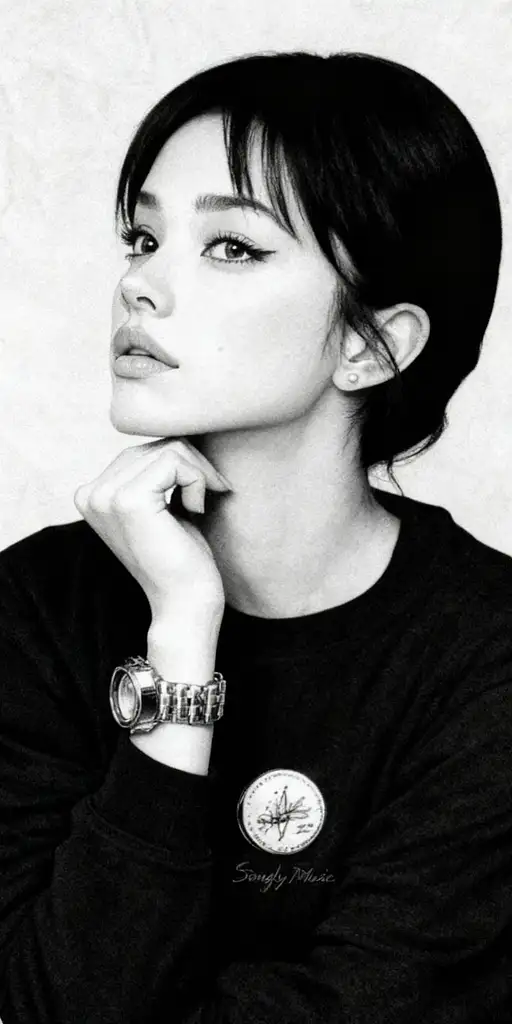
A sample prompt of what you can find in this page
Prompt by car19Cars

Modern era prompts

very few results

7 months ago

Make a simple LOGO/Symbol that represents the following information.. History of the Hakka People - Key Points Here's a breakdown of Hakka history in point form, covering their origins, migrations, culture, and modern situation: **I. Origins & Early History (Pre-Song Dynasty - Before 960 AD)** * **Han Chinese Roots:** The Hakka are a subgroup of the Han Chinese, *not* a separate ethnic group. Their name “Hakka” (客家) literally means “guest families.” * **Northern Origins:** Most scholars believe the Hakka originated from areas of North and Central China (Henan, Shanxi, Shaanxi) during periods of upheaval. * **Multiple Migrations:** They weren’t a single migration, but *waves* of migration southward over centuries, starting as early as the Qin and Han dynasties (221 BC – 220 AD). * **Avoiding Conflict:** These migrations were often driven by political instability, war, and famine. The Hakka tended to move *away* from conflict, not to conquer. * **Early Settlers in Jiangxi:** The Jiangxi province became an early and important staging ground for their southern migrations. **II. The Long Migration & Settlement (Song - Ming Dynasties - 960 - 1644 AD)** * **Southern Migration Intensifies:** The Song Dynasty (960-1279) saw a significant acceleration of Hakka migration southwards. * **Conflict with Existing Populations:** As they moved south, the Hakka often settled in marginal lands or areas already inhabited by other groups (including other Han Chinese, and minority groups like the She and Yao). This led to frequent conflicts and clashes. * **“Guest” Status:** They were often seen as outsiders or "guests" by the existing populations, hence the name “Hakka.” They were often denied full integration. * **Settlement in Guangdong, Fujian, Jiangxi:** The Hakka eventually settled primarily in the provinces of Guangdong, Fujian, and Jiangxi, as well as parts of Sichuan, Hunan, and Guangxi. * **Fortified Villages (Weitou):** Due to constant threats and conflict, the Hakka developed a unique architectural style – fortified, circular villages known as *Weitou* (围头). These served as both homes and defensive structures. * **Development of Distinct Culture:** During this period of migration and isolation, the Hakka developed their own distinct language, customs, and traditions. **III. Qing Dynasty & Modern Era (1644 - Present)** * **Qing Dynasty Stability:** The Qing Dynasty (1644-1912) brought a period of relative stability, allowing the Hakka to consolidate their settlements and develop their economy. * **Continued Marginalization:** However, they remained largely marginalized from mainstream Chinese society, often facing discrimination and economic hardship. * **Taiping Rebellion (1850-1864):** A significant number of Hakka joined the Taiping Rebellion, a large-scale uprising against the Qing Dynasty. This further complicated their relationship with the central government. * **Overseas Migration:** In the late 19th and early 20th centuries, many Hakka emigrated overseas, primarily to Southeast Asia (Malaysia, Indonesia, Thailand, Singapore) and other parts of the world. They became successful merchants and entrepreneurs. * **Communist Revolution (1949):** After the Communist Revolution in 1949, the Hakka were initially seen as a potentially rebellious group due to their history of independence and resistance. * **Recognized as a Minority Group:** In the 1990s, the Chinese government officially recognized the Hakka as one of China’s 56 ethnic groups, though they are still considered a subgroup of the Han Chinese. * **Cultural Revival & Tourism:** In recent decades, there has been a growing interest in Hakka culture and heritage, with efforts to preserve their traditions, language, and architecture. Hakka villages are becoming popular tourist destinations. * **Diaspora Connections:** The Hakka diaspora remains strong, with significant communities around the world maintaining connections to their ancestral homeland. **Key Characteristics of Hakka Culture:** * **Language:** Hakka language (Hakka Hua), a Sinitic language distinct from Mandarin and Cantonese. * **Architecture:** Circular fortified villages (Weitou). * **Cuisine:** Unique Hakka cuisine, known for preserved foods, stuffed tofu, and savory flavors. * **Ancestor Veneration:** Strong emphasis on ancestor worship. * **Matrilineal Traditions (in some areas):** Some Hakka communities retain elements of matrilineal inheritance and family structures. * **Emphasis on Education:** Historically, the Hakka placed a high value on education. This list provides a concise overview of Hakka history and culture. It’s a complex and fascinating story of migration, adaptation, and resilience.

7 months ago

"Ultra-detailed 4K portrait merging Impressionist brushwork with Baroque chiaroscuro. An Egyptian pharaoh with a hyper-realistic face and an ornate gold headdress embedded with lapis lazuli and turquoise dynamically pins down a stylized Israeli soldier. The god Horus looms behind them as a semi-abstract Impressionist figure - iridescent wings blurred in motion, glowing eyes piercing through thick, textured brushstrokes. Lighting features a single dramatic light source from the left, casting sharp shadows on the pharaoh’s determined face and the soldier’s strained muscles, while warm golden rays illuminate hieroglyphic patterns floating in a smoky, abstract background. The color palette includes vibrant Impressionist hues like crimson, burnt orange, and cerulean softened by Baroque-era depth. Textures contrast photorealistic sweat on skin with thick oil-paint strokes on Horus’ feathers. The composition creates diagonal tension between the pharaoh’s spear and Horus’ talons, evoking dynamic movement. The mood is theatrically intense, contrasting the pharaoh’s calm authority with the soldier’s anguish." Additional instructions: Style hybridization: Impressionism meets Caravaggio, hyper-detailed faces, cinematic lighting, f/1.2 aperture for bokeh. Horus: semi-transparent, fragmented brushstrokes suggesting divine wrath. Soldier: modern military uniform stylized with muted, desaturated tones to avoid politicized realism. Lighting: Rembrandt lighting on faces, Monet-style dappled gold highlights on hieroglyphic backgrounds. Use --style raw equivalent for blending realism with artistic brushwork.

9 months ago

An ultra-realistic, full-body portrait of a captivating timekeeper woman, radiating timeless wisdom and temporal power with a serene and luminous palette. She poses thoughtfully, her form exuding both a sense of ancient knowledge and the authority to manipulate the very fabric of time. She wears a modern, flowing gown crafted from interwoven silk and clockwork mechanisms, adorned with ancient symbols, temporal sigils, and shimmering, holographic projections, in a mix of soft blues, luminous whites, and subtle gold accents, creating a celestial and timeless contrast. The gown features intricate patterns, flexible fabrics that seem to shimmer with the movement of time, and embedded crystals that enhance her control over the temporal currents, designed for both elegance and the manipulation of the past, present, and future. Her photorealistic face exudes a calm wisdom and a deep understanding of the flow of time, with delicate features and piercing blue eyes that seem to gaze into all epochs and eras. Her long, silver hair is styled in a complex, braided style adorned with delicate clockwork mechanisms, temporal sigils, and miniature hourglasses that capture the essence of time. Ethereal, temporal tattoos in glowing gold and blue patterns swirl along her arms and face, adding an otherworldly and time-bending charm. She holds a staff topped with a glowing crystal orb that projects holographic timelines and controls the flow of temporal energies, along with a pocket watch that can pause, rewind, or fast-forward moments in history, ready to manipulate the very fabric of time and alter the past and the future. The background is a vivid combination of a temporal library and swirling, abstract energy currents in hues of soft blues, luminous white, and subtle gold, emphasizing her temporal power and authority over the flow of time. Dramatic cinematic lighting casts soft shadows and ethereal highlights, accentuating the precise lines of her pose. The image combines advanced digital artistry techniques, including V-Ray tracing, Unreal Engine 5 rendering, and Substance Painter detailing, with mixed-media digital painting. Every element is brought to life in UHD resolution, showcasing her as a powerful yet elegant timekeeper, blending the aesthetics of historical fantasy, a love for intricate mechanics, and a profound understanding of time in one extraordinary full-body composition.

8 months ago

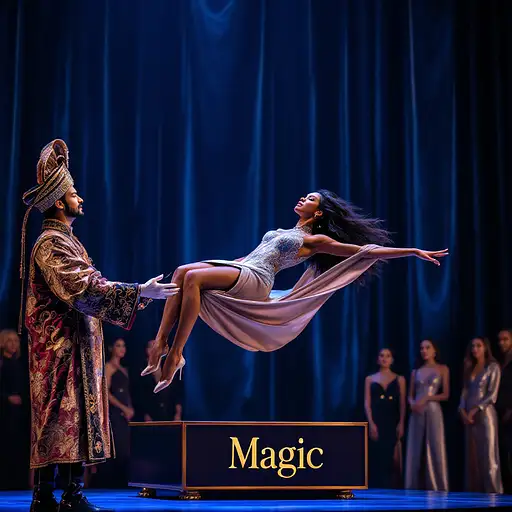
A modern, 2020s-era photorealistic photograph of a grand stage illusion performance. The magician, wearing an elaborately embroidered, jewel-toned ornate robe and a detailed, sparkling turban, performs a stunning levitation act. He holds a Black woman floating horizontally in midair, supported only by two polished chrome poles connected to a lacquered wooden base with bold lettering "GOGIA PASHA." The woman has natural, textured, voluminous hair styled elegantly in a 2020s fashion, and she wears a flowing, luxurious silk robe with intricate modern designs. Her expression is calm and powerful as she leans backward in graceful suspension. Surrounding the act are stylish men dressed in sharp, contemporary tailored suits — fitted blazers, open-collar shirts, some wearing well-groomed beards or fades — watching intently. The background is a rich, heavy velvet stage curtain in dark jewel tones like sapphire blue or deep burgundy, with subtle folds and texture. The lighting is dramatic yet cinematic: a soft but focused key spotlight on the magician and the levitating woman, with natural warm stage tones, deep soft shadows, and crisp edge lighting around their silhouettes. Textures are highly detailed: the embroidered fabric sparkles subtly, the silk robe shimmers with realistic folds, the velvet curtains have visible plushness, and the wooden stage floor reflects faintly under the lights. Camera and Lens Settings: Shot with a Canon EOS R5 mirrorless camera 50mm prime lens, aperture f/1.8 for shallow depth of field ISO 400 for clean image with natural grain Shutter speed 1/250s to freeze motion Natural cinematic color grading with rich contrast and slight filmic softness Hyper-realistic focus on subject; slight bokeh on background observers. Additional details for realism: Authentic skin texture: natural pores, subtle makeup glow. Realistic hair texture and natural light highlights. Real-world imperfections like minor wrinkles in clothing, slight stage dust, small hand movements. Lens flare subtly visible from stage lights. Full stage atmosphere: polished wood grain on floor, tiny metallic glints on chrome poles, realistic shadow behavior.

8 months ago

A modern, 2020s-era photorealistic photograph of a grand stage illusion performance. The magician, wearing an elaborately embroidered, jewel-toned ornate robe and a detailed, sparkling turban, performs a stunning levitation act. He holds a young Black woman floating horizontally in midair, supported only by two polished chrome poles connected to a lacquered wooden base with bold lettering "GOGIA PASHA." The woman has natural, textured, voluminous long hair styled elegantly in a 2020s fashion, and she wears a flowing, luxurious silk satin cheongsam with a high slit in the middle showing her beautiful legs with intricate modern designs. Her expression is calm and powerful as she leans backward in graceful suspension. Surrounding the act are stylish men dressed in sharp, contemporary tailored suits — fitted blazers, open-collar shirts, some wearing well-groomed beards or fades — watching intently. The background is a rich, heavy velvet stage curtain in dark jewel tones like sapphire blue or deep burgundy, with subtle folds and texture. The lighting is dramatic yet cinematic: a soft but focused key spotlight on the magician and the levitating woman, with natural warm stage tones, deep soft shadows, and crisp edge lighting around their silhouettes. Textures are highly detailed: the embroidered fabric sparkles subtly, the silk robe shimmers with realistic folds, the velvet curtains have visible plushness, and the wooden stage floor reflects faintly under the lights. Camera and Lens Settings: Shot with a Canon EOS R5 mirrorless camera 50mm prime lens, aperture f/1.8 for shallow depth of field ISO 400 for clean image with natural grain Shutter speed 1/250s to freeze motion Natural cinematic color grading with rich contrast and slight filmic softness Hyper-realistic focus on subject; slight bokeh on background observers. Additional details for realism: Authentic skin texture: natural pores, subtle makeup glow. Realistic hair texture and natural light highlights. Real-world imperfections like minor wrinkles in clothing, slight stage dust, small hand movements. Lens flare subtly visible from stage lights. Full stage atmosphere: polished wood grain on floor, tiny metallic glints on chrome poles, realistic shadow behavior.