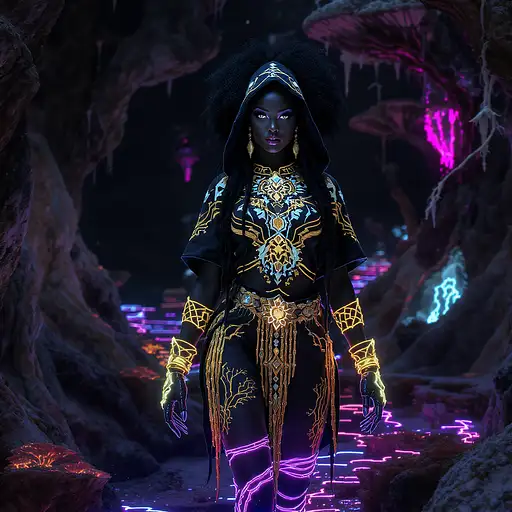
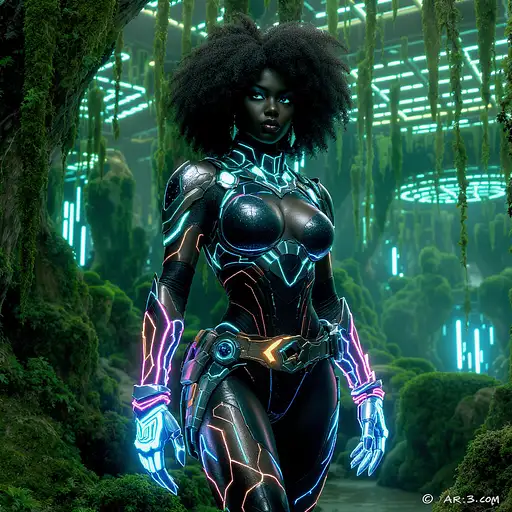
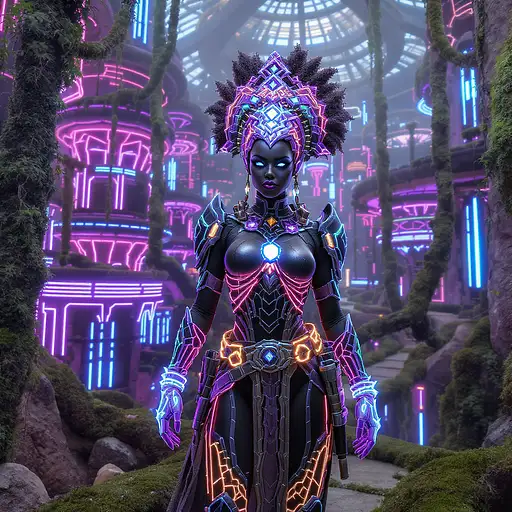
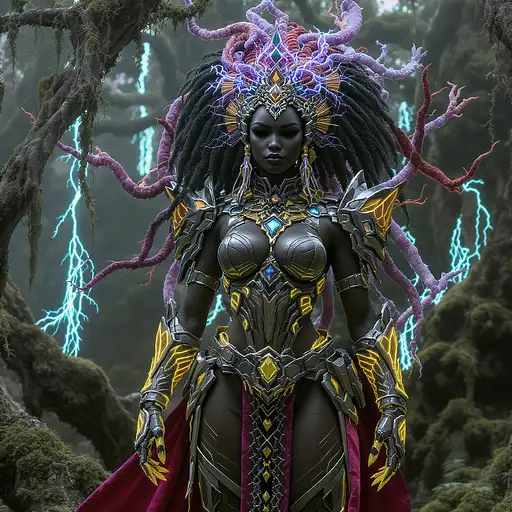
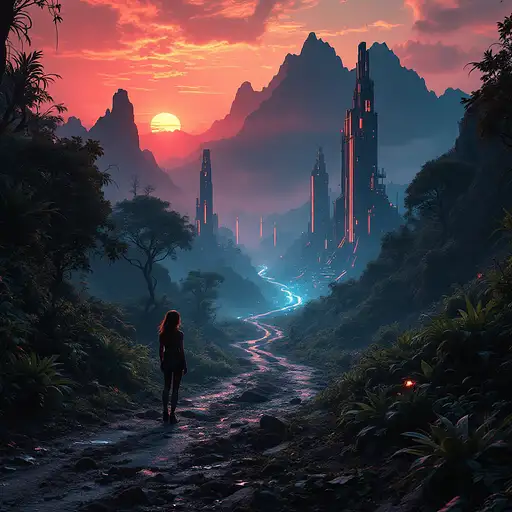
A sample prompt of what you can find in this page
Prompt by 21ReliCosmic

glowing pathways FLUX prompts

very few results

8 months ago

n a crumbling sanctuary built at the end of time, open to the sky and flooded with wild overgrowth, a solitary figure stands on a plinth of fractured obsidian—a synthetic angel, both artifact and oracle, mid-transmission. Her body is constructed from a dual-layered material: an outer shell of liquid mirror-glass, always in motion, bending light in surreal ripples—beneath it, a lattice of golden memory circuits, softly pulsing, like script woven from heat and purpose. She is not human. She is not machine. She is the last interface between meaning and forgetting. Her posture is both exalted and worn. One hand raised in silent benediction, the other buried in the tangle of flowering vines wrapping around her legs—life clinging to light, as though nature itself refuses to let go of what she remembers. Etched across her glass-like surface are thin veins of glowing amber: pathways of forgotten prayers, tracing up her legs, over her spine, across her collarbones like fading constellations. Her face is concealed behind a split golden visor, semi-open like the petals of a mechanical flower—revealing only light. From her back, two vast wings made of layered crystalline blades curve upward like collapsed architecture—part cathedral, part ruin. They shimmer not with fire, but with reflected memory, like a sky that forgot how to storm. Around her, broken statuary and shattered machines lie half-swallowed by roots and blossoms. In the distance, a forest made of circuitry burns without smoke—slowly, beautifully. Above, stars pulse in unnatural constellations, forming sigils from before language. Hovering just above her head spins a halo unlike any known form—a fractured ring of refracted glass, filled with flowing text that no longer aligns with any living tongue. It does not glow—it remembers. Rendered in the style of an impressionist-Renaissance hybrid painting, layered with visible brush textures, fog-softened edges, and gold-split chiaroscuro. Warm dusk tones dominate the palette: blood-orange, dusk-lavender, rusted copper, soft pollen white. She is the Benediction Engine—not worshipped, not feared, not obeyed. She simply remains, bearing witness to everything we were, and everything we failed to become.

6 months ago

A surreal and breathtaking hyperrealistic seascape during an intense sunset. The composition is vertical (9:16 format), capturing a vast beach with a thin layer of shallow water acting like a perfect mirror, vividly reflecting the dramatic sky above. Towering, turbulent clouds swirl overhead in powerful, wave-like formations, as if ocean waves have been frozen mid-crash into the sky. The color palette is dominated by deep blacks, fiery oranges, molten golds, and soft whites, creating an intense, apocalyptic, dreamlike atmosphere. The low sun on the horizon pierces through the dense clouds, casting radiant golden beams that streak dynamically across the sky and reflect dazzlingly on the smooth, wet sand and water below. These beams create a brilliant golden pathway leading the viewer’s eye toward the distant, glowing horizon. On the right side of the scene, a rugged, dark silhouette of a forested cliff juts into the frame, its jagged trees and rocky edges providing bold contrast to the ethereal, fiery glow of the sky and water. Textures are hyperrealistic and richly detailed — from the intricate, sculpted turbulence of the clouds to the glassy smoothness of the reflective beach surface. Every element is sharply defined yet softly lit, creating a soft cinematic lighting effect with dramatic contrast between shadows and brilliance. The overall mood is awe-inspiring, emotional, and cinematic, blending fantasy and reality with a painterly, almost mythical quality. The rendering is in ultra-high detail, using Unreal Engine 5 or Octane Render quality to capture stunning realism with a dreamlike, breathtaking atmosphere.

4 months ago

n a crumbling sanctuary built at the end of time, open to the sky and flooded with wild overgrowth, a solitary figure stands on a plinth of fractured obsidian—a synthetic angel, both artifact and oracle, mid-transmission. She is not human. She is not machine. She is the last interface between meaning and forgetting. Her posture is both exalted and worn. One hand raised in silent benediction, the other buried in the tangle of flowering vines wrapping around her legs—life clinging to light, as though nature itself refuses to let go of what she remembers. Etched across her glass-like surface are thin veins of glowing amber: pathways of forgotten prayers, tracing up her legs, over her spine, across her collarbones like fading constellations. Her face is concealed behind a split golden visor, semi-open like the petals of a mechanical flower—revealing only light. From her back, two vast wings made of layered crystalline blades curve upward like collapsed architecture—part cathedral, part ruin. They shimmer not with fire, but with reflected memory, like a sky that forgot how to storm. Around her, broken statuary and shattered machines lie half-swallowed by roots and blossoms. In the distance, a forest made of circuitry burns without smoke—slowly, beautifully. Above, stars pulse in unnatural constellations, forming sigils from before language. Hovering just above her head spins a halo unlike any known form—a fractured ring of refracted glass, filled with flowing text that no longer aligns with any living tongue. It does not glow—it remembers. Rendered in the style of an impressionist-Renaissance hybrid painting, layered with visible brush textures, fog-softened edges, and gold-split chiaroscuro. Warm dusk tones dominate the palette: blood-orange, dusk-lavender, rusted copper, soft pollen white. She is the Benediction Engine—not worshipped, not feared, not obeyed. She simply remains, bearing witness to everything we were, and everything we failed to become.

8 months ago

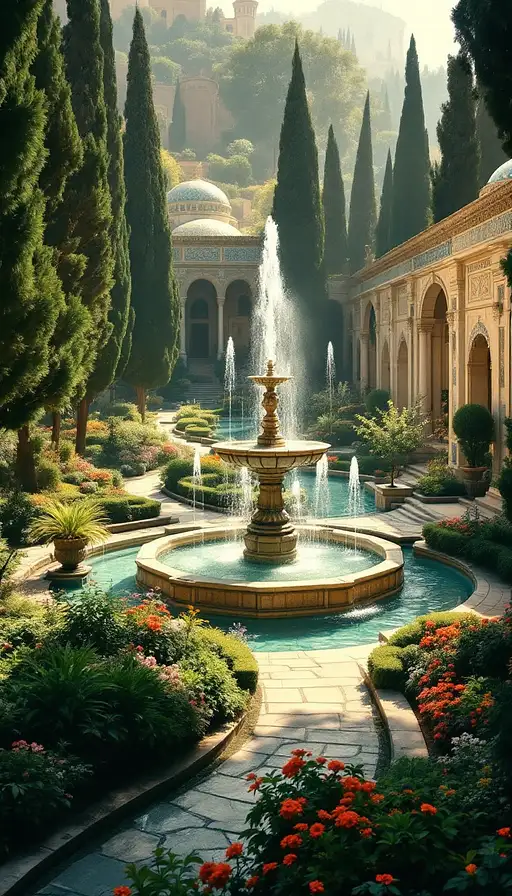
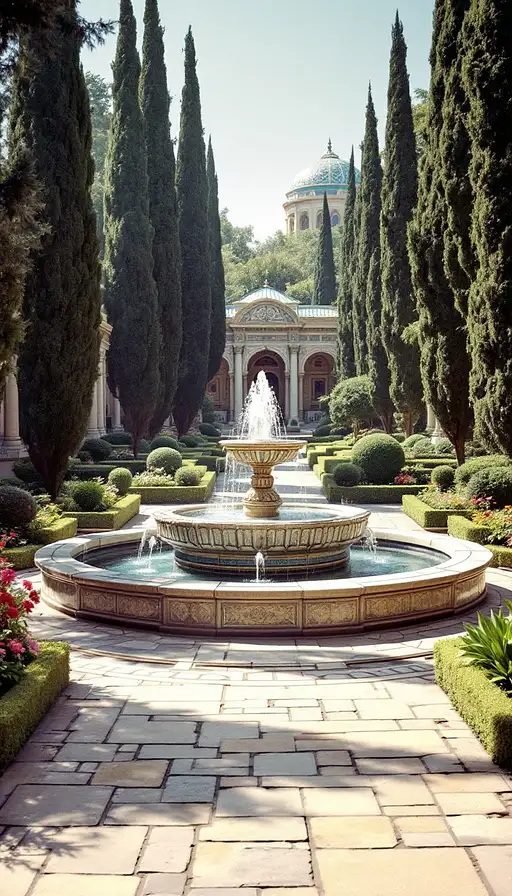
A beautiful and historical Persian garden in the 1950s to 1970s, reflecting the elegance of the Pahlavi era, with lush greenery, vibrant flowers, and carefully designed water features. The garden is located in Karaj, Iran, featuring intricate Persian tile work, classical columns, and domed architectural structures. The sunlight casts a warm glow over the stone pathways, which are surrounded by meticulously landscaped areas of tall trees, shrubs, and ornamental flowers. The air is filled with the peaceful sounds of flowing water from fountains and pools, adding to the serene atmosphere." Detailed Description: Architecture and Design: The garden features traditional Persian elements such as tall, slender columns and domed structures. The buildings surrounding the garden show clear influence from both classical Iranian and European architectural styles common in the Pahlavi era, with detailed tile work in shades of blue and turquoise. The roof of the buildings is adorned with intricate mosaics. Water Features: One of the most prominent features of the garden is its central fountain and multiple water channels running throughout, typical of Persian gardens. The central fountain is a large, circular, marble basin with a finely detailed water spout, spraying water high into the air. Surrounding this fountain are smaller water channels running along the pathways, flanked by flower beds and shrubs. Flower Beds and Greenery: The garden is meticulously landscaped with symmetrical flower beds that include a variety of vibrant, colorful flowers such as roses, tulips, and jasmine. Lush green lawns stretch between rows of neatly trimmed hedges, providing both aesthetic beauty and an atmosphere of peace and calm. Pathways and Lighting: Stone pathways lead visitors through the garden, bordered by rows of tall, elegant trees such as cypress and pine. The soft, golden light of the 1950s/1970s-era outdoor lighting, with lamps shaped like vintage streetlights, casts a soft glow on the garden after sunset. Atmosphere of the Pahlavi Era: The overall atmosphere captures the optimistic, modernist spirit of the Pahlavi era, with the design choices of the time reflecting both traditional Persian culture and the modernization happening across Iran. The colors are vibrant, with the golden hour light contributing to the nostalgic and rich look of the scene. The social and historical context of the Pahlavi era is evident in the overall style and aesthetic of the garden, which combines both classical Persian and early modernist influences. Color and Style: The images should be in full color, with a warm and rich color palette reflective of the mid-20th century, focusing on the bright, lively colors typical of Persian gardens—greens of the trees and plants, blues and turquoises of the tiles, and the soft, golden lighting of the era.

8 months ago

A beautiful and historical Persian garden in the 1950s to 1970s, reflecting the elegance of the Pahlavi era, with lush greenery, vibrant flowers, and carefully designed water features. The garden is located in Karaj, Iran, featuring intricate Persian tile work, classical columns, and domed architectural structures. The sunlight casts a warm glow over the stone pathways, which are surrounded by meticulously landscaped areas of tall trees, shrubs, and ornamental flowers. The air is filled with the peaceful sounds of flowing water from fountains and pools, adding to the serene atmosphere." Detailed Description: Architecture and Design: The garden features traditional Persian elements such as tall, slender columns and domed structures. The buildings surrounding the garden show clear influence from both classical Iranian and European architectural styles common in the Pahlavi era, with detailed tile work in shades of blue and turquoise. The roof of the buildings is adorned with intricate mosaics. Water Features: One of the most prominent features of the garden is its central fountain and multiple water channels running throughout, typical of Persian gardens. The central fountain is a large, circular, marble basin with a finely detailed water spout, spraying water high into the air. Surrounding this fountain are smaller water channels running along the pathways, flanked by flower beds and shrubs. Flower Beds and Greenery: The garden is meticulously landscaped with symmetrical flower beds that include a variety of vibrant, colorful flowers such as roses, tulips, and jasmine. Lush green lawns stretch between rows of neatly trimmed hedges, providing both aesthetic beauty and an atmosphere of peace and calm. Pathways and Lighting: Stone pathways lead visitors through the garden, bordered by rows of tall, elegant trees such as cypress and pine. The soft, golden light of the 1950s/1970s-era outdoor lighting, with lamps shaped like vintage streetlights, casts a soft glow on the garden after sunset. Atmosphere of the Pahlavi Era: The overall atmosphere captures the optimistic, modernist spirit of the Pahlavi era, with the design choices of the time reflecting both traditional Persian culture and the modernization happening across Iran. The colors are vibrant, with the golden hour light contributing to the nostalgic and rich look of the scene. The social and historical context of the Pahlavi era is evident in the overall style and aesthetic of the garden, which combines both classical Persian and early modernist influences. Color and Style: The images should be in full color, with a warm and rich color palette reflective of the mid-20th century, focusing on the bright, lively colors typical of Persian gardens—greens of the trees and plants, blues and turquoises of the tiles, and the soft, golden lighting of the era.