A sample prompt of what you can find in this page
Prompt by wildcat2

traditional architecture elements FLUX prompts

very few results

5 months ago

The image depicts a stunning, ethereal woman with prominent, fluffy white fox ears and a large, flowing white fox tail that billows around her. She has long, wavy, white hair that cascades down her back and shoulders, some strands appearing to float around her. Her eyes are closed, and her head is slightly bowed, giving her a serene and contemplative expression. Her makeup is delicate, with a touch of pink blush on her cheeks and subtle eye makeup. She is adorned with a beautiful, intricate silver necklace. She is wearing an elaborate white kimono-style outfit with off-the-shoulder sleeves. The garment is accented with delicate red embroidery, featuring floral or nature-inspired patterns, particularly on the bodice and sleeves. The edges of the sleeves and the neckline have a contrasting red trim. The lower part of her dress is a flowing, multi-layered white skirt that appears to be made of light, airy fabric, creating a sense of movement and grace. Her hands are delicately positioned, one extended slightly with fingers pointed, and the other tucked into the folds of her sleeves. The background is a soft, blurred winter landscape. Snow is falling gently, with visible snowflakes in the air. The setting appears to be outdoors, with hints of snow-covered trees and possibly a traditional Japanese-style building in the distance, creating a tranquil and magical atmosphere. The overall impression is one of delicate beauty, fantasy, and a connection with nature. Prompt for Realistic Image Generation: "A hyperrealistic, full-body portrait of a beautiful Kitsune woman with large, fluffy white fox ears and a voluminous white fox tail. She has long, flowing, wavy white hair that appears to move in a gentle breeze. Her expression is serene, with closed eyes and a slightly bowed head. She is wearing an exquisite white off-the-shoulder kimono with intricate red floral embroidery on the bodice and sleeves. The kimono has delicate red trim along the edges and a flowing, layered white skirt. She wears a sparkling silver necklace. The scene is set against a soft-focus, blurred winter background with gently falling snow, hinting at snow-covered trees and a traditional Japanese architectural element in the distance. The lighting is soft and diffused, creating an ethereal and magical atmosphere."

5 months ago

The image depicts a stunning, ethereal woman with prominent, fluffy white fox ears and a large, flowing white fox tail that billows around her. She has long, wavy, white hair that cascades down her back and shoulders, some strands appearing to float around her. Her eyes are closed, and her head is slightly bowed, giving her a serene and contemplative expression. Her makeup is delicate, with a touch of pink blush on her cheeks and subtle eye makeup. She is adorned with a beautiful, intricate silver necklace. She is wearing an elaborate white kimono-style outfit with off-the-shoulder sleeves. The garment is accented with delicate red embroidery, featuring floral or nature-inspired patterns, particularly on the bodice and sleeves. The edges of the sleeves and the neckline have a contrasting red trim. The lower part of her dress is a flowing, multi-layered white skirt that appears to be made of light, airy fabric, creating a sense of movement and grace. Her hands are delicately positioned, one extended slightly with fingers pointed, and the other tucked into the folds of her sleeves. The background is a soft, blurred winter landscape. Snow is falling gently, with visible snowflakes in the air. The setting appears to be outdoors, with hints of snow-covered trees and possibly a traditional Japanese-style building in the distance, creating a tranquil and magical atmosphere. The overall impression is one of delicate beauty, fantasy, and a connection with nature. Prompt for Realistic Image Generation: "A hyperrealistic, full-body portrait of a beautiful Kitsune woman with large, fluffy white fox ears and a voluminous white fox tail. She has long, flowing, wavy white hair that appears to move in a gentle breeze. Her expression is serene, with closed eyes and a slightly bowed head. She is wearing an exquisite white off-the-shoulder kimono with intricate red floral embroidery on the bodice and sleeves. The kimono has delicate red trim along the edges and a flowing, layered white skirt. She wears a sparkling silver necklace. The scene is set against a soft-focus, blurred winter background with gently falling snow, hinting at snow-covered trees and a traditional Japanese architectural element in the distance. The lighting is soft and diffused, creating an ethereal and magical atmosphere."

6 months ago

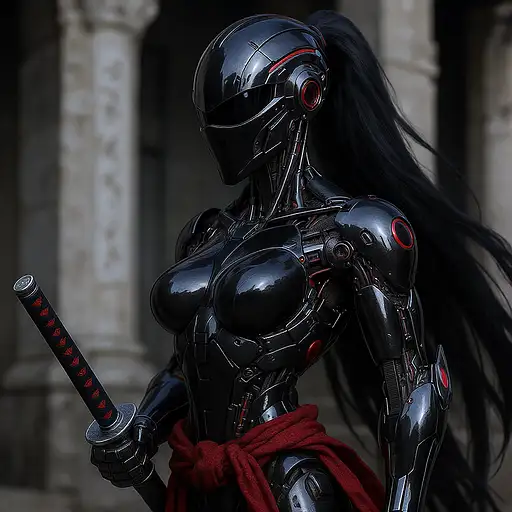
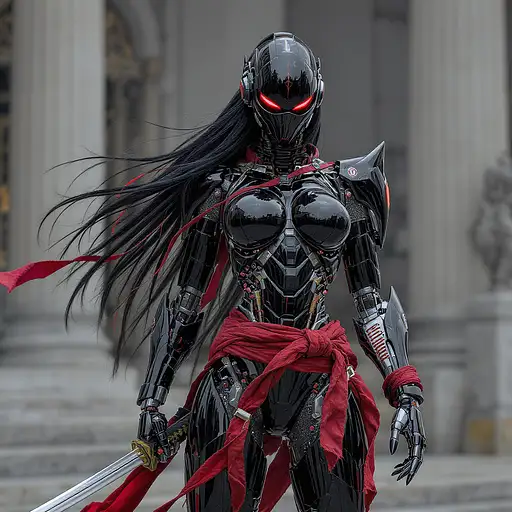
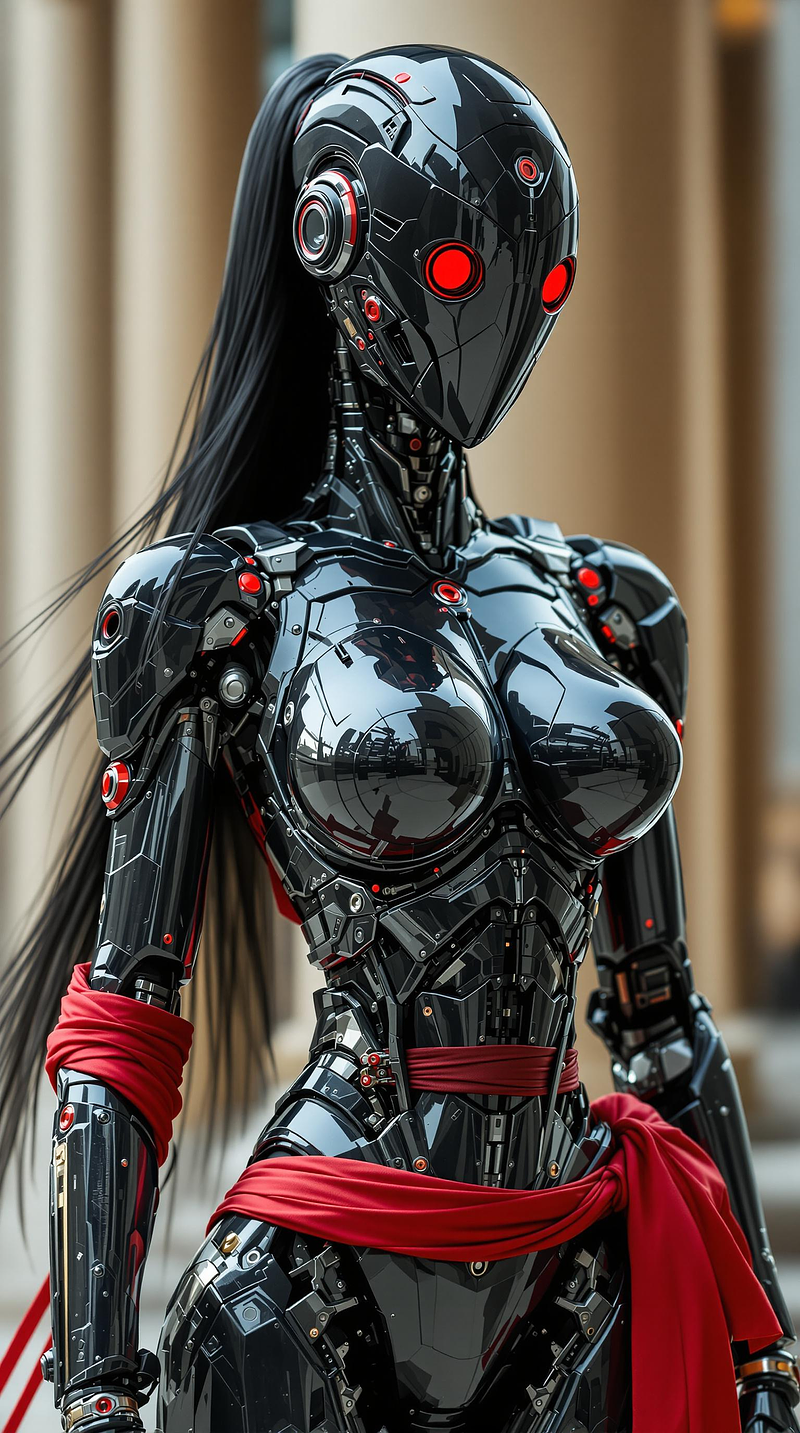
The image depicts a highly detailed and stylized depiction of a ((humanoid woman ninja warrior robot)) with an Asian-inspired aesthetic. The robot is predominantly black, featuring sleek metallic surfaces that reflect light, giving it a glossy appearance. Red accents are strategically placed throughout the design, highlighting various joints, panels, and components. The robot's head is covered by a helmet-like structure with a visor, which appears to be made from a reflective material. This helmet has red circular elements around its eyes, adding to the futuristic look. The femal body including breast armor is adorned with intricate mechanical details, including visible wires and circuits, suggesting advanced technology within the robot. A striking feature is the long, flowing black hair that cascades down the back and sides of the robot, contrasting with the shiny metal. The robot also wears a red sash or cloth wrapped around its waist, adding a touch of color and texture to the overall design. In one hand, the robot holds a sword with a black handle and a silver blade, which complements the red accents on the rest of the robot. The background features blurred architectural elements, possibly columns or pillars, contributing to the sense of depth and setting in this futuristic scene. Overall, the image combines elements of cyberpunk aesthetics with traditional Asian influences, creating a visually captivating and imaginative portrayal of a robotic figure.

6 months ago

The image depicts a highly detailed and stylized depiction of a ((humanoid woman ninja warrior robot)) with an Asian-inspired aesthetic. The robot is predominantly black, featuring sleek metallic surfaces that reflect light, giving it a glossy appearance. Red accents are strategically placed throughout the design, highlighting various joints, panels, and components. The robot's head is covered by a helmet-like structure with a visor, which appears to be made from a reflective material. This helmet has red circular elements around its eyes, adding to the futuristic look. The femal body including breast armor is adorned with intricate mechanical details, including visible wires and circuits, suggesting advanced technology within the robot. A striking feature is the long, flowing black hair that cascades down the back and sides of the robot, contrasting with the shiny metal. The robot also wears a red sash or cloth wrapped around its waist, adding a touch of color and texture to the overall design. In one hand, the robot holds a sword with a black handle and a silver blade, which complements the red accents on the rest of the robot. The background features blurred architectural elements, possibly columns or pillars, contributing to the sense of depth and setting in this futuristic scene. Overall, the image combines elements of cyberpunk aesthetics with traditional Asian influences, creating a visually captivating and imaginative portrayal of a robotic figure.

7 months ago

Make a simple LOGO/Symbol that represents the following information.. History of the Hakka People - Key Points Here's a breakdown of Hakka history in point form, covering their origins, migrations, culture, and modern situation: **I. Origins & Early History (Pre-Song Dynasty - Before 960 AD)** * **Han Chinese Roots:** The Hakka are a subgroup of the Han Chinese, *not* a separate ethnic group. Their name “Hakka” (客家) literally means “guest families.” * **Northern Origins:** Most scholars believe the Hakka originated from areas of North and Central China (Henan, Shanxi, Shaanxi) during periods of upheaval. * **Multiple Migrations:** They weren’t a single migration, but *waves* of migration southward over centuries, starting as early as the Qin and Han dynasties (221 BC – 220 AD). * **Avoiding Conflict:** These migrations were often driven by political instability, war, and famine. The Hakka tended to move *away* from conflict, not to conquer. * **Early Settlers in Jiangxi:** The Jiangxi province became an early and important staging ground for their southern migrations. **II. The Long Migration & Settlement (Song - Ming Dynasties - 960 - 1644 AD)** * **Southern Migration Intensifies:** The Song Dynasty (960-1279) saw a significant acceleration of Hakka migration southwards. * **Conflict with Existing Populations:** As they moved south, the Hakka often settled in marginal lands or areas already inhabited by other groups (including other Han Chinese, and minority groups like the She and Yao). This led to frequent conflicts and clashes. * **“Guest” Status:** They were often seen as outsiders or "guests" by the existing populations, hence the name “Hakka.” They were often denied full integration. * **Settlement in Guangdong, Fujian, Jiangxi:** The Hakka eventually settled primarily in the provinces of Guangdong, Fujian, and Jiangxi, as well as parts of Sichuan, Hunan, and Guangxi. * **Fortified Villages (Weitou):** Due to constant threats and conflict, the Hakka developed a unique architectural style – fortified, circular villages known as *Weitou* (围头). These served as both homes and defensive structures. * **Development of Distinct Culture:** During this period of migration and isolation, the Hakka developed their own distinct language, customs, and traditions. **III. Qing Dynasty & Modern Era (1644 - Present)** * **Qing Dynasty Stability:** The Qing Dynasty (1644-1912) brought a period of relative stability, allowing the Hakka to consolidate their settlements and develop their economy. * **Continued Marginalization:** However, they remained largely marginalized from mainstream Chinese society, often facing discrimination and economic hardship. * **Taiping Rebellion (1850-1864):** A significant number of Hakka joined the Taiping Rebellion, a large-scale uprising against the Qing Dynasty. This further complicated their relationship with the central government. * **Overseas Migration:** In the late 19th and early 20th centuries, many Hakka emigrated overseas, primarily to Southeast Asia (Malaysia, Indonesia, Thailand, Singapore) and other parts of the world. They became successful merchants and entrepreneurs. * **Communist Revolution (1949):** After the Communist Revolution in 1949, the Hakka were initially seen as a potentially rebellious group due to their history of independence and resistance. * **Recognized as a Minority Group:** In the 1990s, the Chinese government officially recognized the Hakka as one of China’s 56 ethnic groups, though they are still considered a subgroup of the Han Chinese. * **Cultural Revival & Tourism:** In recent decades, there has been a growing interest in Hakka culture and heritage, with efforts to preserve their traditions, language, and architecture. Hakka villages are becoming popular tourist destinations. * **Diaspora Connections:** The Hakka diaspora remains strong, with significant communities around the world maintaining connections to their ancestral homeland. **Key Characteristics of Hakka Culture:** * **Language:** Hakka language (Hakka Hua), a Sinitic language distinct from Mandarin and Cantonese. * **Architecture:** Circular fortified villages (Weitou). * **Cuisine:** Unique Hakka cuisine, known for preserved foods, stuffed tofu, and savory flavors. * **Ancestor Veneration:** Strong emphasis on ancestor worship. * **Matrilineal Traditions (in some areas):** Some Hakka communities retain elements of matrilineal inheritance and family structures. * **Emphasis on Education:** Historically, the Hakka placed a high value on education. This list provides a concise overview of Hakka history and culture. It’s a complex and fascinating story of migration, adaptation, and resilience.
5 months ago

The image depicts a stunning, ethereal woman with prominent, fluffy white fox ears and a large, flowing white fox tail that billows around her. She has long, wavy, white hair that cascades down her back and shoulders, some strands appearing to float around her. Her eyes are closed, and her head is slightly bowed, giving her a serene and contemplative expression. Her makeup is delicate, with a touch of pink blush on her cheeks and subtle eye makeup. She is adorned with a beautiful, intricate silver necklace. She is wearing an elaborate white kimono-style outfit with off-the-shoulder sleeves. The garment is accented with delicate red embroidery, featuring floral or nature-inspired patterns, particularly on the bodice and sleeves. The edges of the sleeves and the neckline have a contrasting red trim. The lower part of her dress is a flowing, multi-layered white skirt that appears to be made of light, airy fabric, creating a sense of movement and grace. Her hands are delicately positioned, one extended slightly with fingers pointed, and the other tucked into the folds of her sleeves. The background is a soft, blurred winter landscape. Snow is falling gently, with visible snowflakes in the air. The setting appears to be outdoors, with hints of snow-covered trees and possibly a traditional Japanese-style building in the distance, creating a tranquil and magical atmosphere. The overall impression is one of delicate beauty, fantasy, and a connection with nature. Prompt for Realistic Image Generation: "A hyperrealistic, full-body portrait of a beautiful Kitsune woman with large, fluffy white fox ears and a voluminous white fox tail. She has long, flowing, wavy white hair that appears to move in a gentle breeze. Her expression is serene, with closed eyes and a slightly bowed head. She is wearing an exquisite white off-the-shoulder kimono with intricate red floral embroidery on the bodice and sleeves. The kimono has delicate red trim along the edges and a flowing, layered white skirt. She wears a sparkling silver necklace. The scene is set against a soft-focus, blurred winter background with gently falling snow, hinting at snow-covered trees and a traditional Japanese architectural element in the distance. The lighting is soft and diffused, creating an ethereal and magical atmosphere."

8 months ago

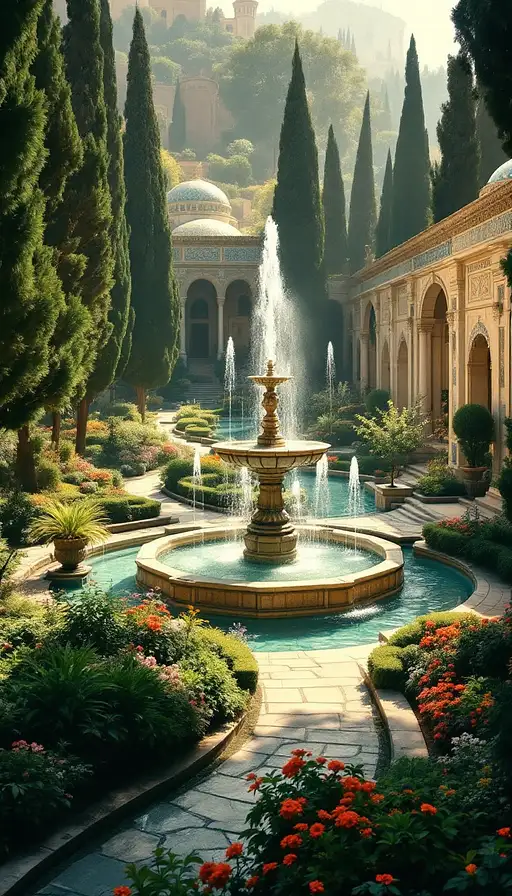
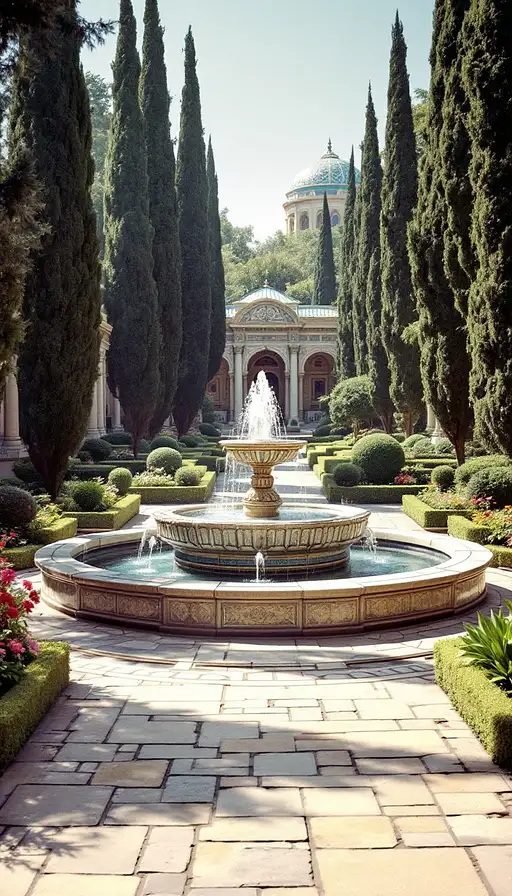
A beautiful and historical Persian garden in the 1950s to 1970s, reflecting the elegance of the Pahlavi era, with lush greenery, vibrant flowers, and carefully designed water features. The garden is located in Karaj, Iran, featuring intricate Persian tile work, classical columns, and domed architectural structures. The sunlight casts a warm glow over the stone pathways, which are surrounded by meticulously landscaped areas of tall trees, shrubs, and ornamental flowers. The air is filled with the peaceful sounds of flowing water from fountains and pools, adding to the serene atmosphere." Detailed Description: Architecture and Design: The garden features traditional Persian elements such as tall, slender columns and domed structures. The buildings surrounding the garden show clear influence from both classical Iranian and European architectural styles common in the Pahlavi era, with detailed tile work in shades of blue and turquoise. The roof of the buildings is adorned with intricate mosaics. Water Features: One of the most prominent features of the garden is its central fountain and multiple water channels running throughout, typical of Persian gardens. The central fountain is a large, circular, marble basin with a finely detailed water spout, spraying water high into the air. Surrounding this fountain are smaller water channels running along the pathways, flanked by flower beds and shrubs. Flower Beds and Greenery: The garden is meticulously landscaped with symmetrical flower beds that include a variety of vibrant, colorful flowers such as roses, tulips, and jasmine. Lush green lawns stretch between rows of neatly trimmed hedges, providing both aesthetic beauty and an atmosphere of peace and calm. Pathways and Lighting: Stone pathways lead visitors through the garden, bordered by rows of tall, elegant trees such as cypress and pine. The soft, golden light of the 1950s/1970s-era outdoor lighting, with lamps shaped like vintage streetlights, casts a soft glow on the garden after sunset. Atmosphere of the Pahlavi Era: The overall atmosphere captures the optimistic, modernist spirit of the Pahlavi era, with the design choices of the time reflecting both traditional Persian culture and the modernization happening across Iran. The colors are vibrant, with the golden hour light contributing to the nostalgic and rich look of the scene. The social and historical context of the Pahlavi era is evident in the overall style and aesthetic of the garden, which combines both classical Persian and early modernist influences. Color and Style: The images should be in full color, with a warm and rich color palette reflective of the mid-20th century, focusing on the bright, lively colors typical of Persian gardens—greens of the trees and plants, blues and turquoises of the tiles, and the soft, golden lighting of the era.

8 months ago

A beautiful and historical Persian garden in the 1950s to 1970s, reflecting the elegance of the Pahlavi era, with lush greenery, vibrant flowers, and carefully designed water features. The garden is located in Karaj, Iran, featuring intricate Persian tile work, classical columns, and domed architectural structures. The sunlight casts a warm glow over the stone pathways, which are surrounded by meticulously landscaped areas of tall trees, shrubs, and ornamental flowers. The air is filled with the peaceful sounds of flowing water from fountains and pools, adding to the serene atmosphere." Detailed Description: Architecture and Design: The garden features traditional Persian elements such as tall, slender columns and domed structures. The buildings surrounding the garden show clear influence from both classical Iranian and European architectural styles common in the Pahlavi era, with detailed tile work in shades of blue and turquoise. The roof of the buildings is adorned with intricate mosaics. Water Features: One of the most prominent features of the garden is its central fountain and multiple water channels running throughout, typical of Persian gardens. The central fountain is a large, circular, marble basin with a finely detailed water spout, spraying water high into the air. Surrounding this fountain are smaller water channels running along the pathways, flanked by flower beds and shrubs. Flower Beds and Greenery: The garden is meticulously landscaped with symmetrical flower beds that include a variety of vibrant, colorful flowers such as roses, tulips, and jasmine. Lush green lawns stretch between rows of neatly trimmed hedges, providing both aesthetic beauty and an atmosphere of peace and calm. Pathways and Lighting: Stone pathways lead visitors through the garden, bordered by rows of tall, elegant trees such as cypress and pine. The soft, golden light of the 1950s/1970s-era outdoor lighting, with lamps shaped like vintage streetlights, casts a soft glow on the garden after sunset. Atmosphere of the Pahlavi Era: The overall atmosphere captures the optimistic, modernist spirit of the Pahlavi era, with the design choices of the time reflecting both traditional Persian culture and the modernization happening across Iran. The colors are vibrant, with the golden hour light contributing to the nostalgic and rich look of the scene. The social and historical context of the Pahlavi era is evident in the overall style and aesthetic of the garden, which combines both classical Persian and early modernist influences. Color and Style: The images should be in full color, with a warm and rich color palette reflective of the mid-20th century, focusing on the bright, lively colors typical of Persian gardens—greens of the trees and plants, blues and turquoises of the tiles, and the soft, golden lighting of the era.

6 months ago

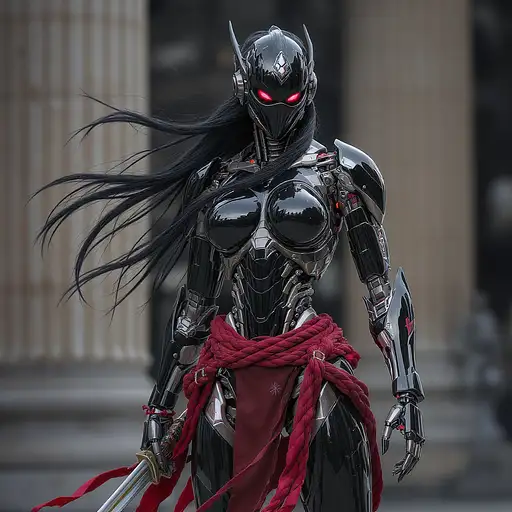
Full body view a highly detailed and stylized depiction of a ((humanoid woman ninja warrior robot)) with an Asian-inspired aesthetic. The robot is predominantly black, featuring sleek metallic surfaces that reflect light, giving it a glossy appearance. Red accents are strategically placed throughout the design, highlighting various joints, panels, and components. The robot's head is covered by a helmet-like structure with a visor, which appears to be made from a reflective material. This helmet has red circular elements around its eyes, adding to the futuristic look. The femal body including breast armor is adorned with intricate mechanical details, including visible wires and circuits, suggesting advanced technology within the robot. A striking feature is the long, flowing black hair that cascades down the back and sides of the robot, contrasting with the shiny metal. The robot also wears a thick red rope wrapped around the waist, adding a touch of color and texture to the overall design. In one hand, the robot holds a sword with a black handle and a silver blade, which complements the red accents on the rest of the robot. Metallic robotic feet simulate toes to appear barefoot. The background features blurred architectural elements, possibly columns or pillars, contributing to the sense of depth and setting in this futuristic scene. Overall, the image combines elements of cyberpunk aesthetics with traditional Asian influences, creating a visually captivating and imaginative portrayal of a robotic figure.

6 months ago

Full body view a highly detailed and stylized depiction of a ((humanoid woman ninja warrior robot)) with an Asian-inspired aesthetic. The robot is predominantly black, featuring sleek metallic surfaces that reflect light, giving it a glossy appearance. Red accents are strategically placed throughout the design, highlighting various joints, panels, and components. The robot's head is covered by a helmet-like structure with a visor, which appears to be made from a reflective material. This helmet has red circular elements around its eyes, adding to the futuristic look. The femal body including breast armor is adorned with intricate mechanical details, including visible wires and circuits, suggesting advanced technology within the robot. A striking feature is the long, flowing black hair that cascades down the back and sides of the robot, contrasting with the shiny metal. The robot also wears a thick red rope wrapped around the waist, adding a touch of color and texture to the overall design. In one hand, the robot holds a sword with a black handle and a silver blade, which complements the red accents on the rest of the robot. Metallic robotic feet simulate toes to appear barefoot. The background features blurred architectural elements, possibly columns or pillars, contributing to the sense of depth and setting in this futuristic scene. Overall, the image combines elements of cyberpunk aesthetics with traditional Asian influences, creating a visually captivating and imaginative portrayal of a robotic figure.

7 months ago

Scene Description: The image captures a dynamic and celebratory moment during a liturgical event or worship concert inside a church, blending traditional Catholic elements with contemporary music and worship. Setting: The event takes place inside a spacious and architecturally rich church, with tall columns, archways, and ornate wooden furnishings. The altar is adorned with a lace-trimmed white cloth, floral arrangements with red anthuriums, and three large yellow candles featuring red bands. In the background stands a large crucifix, partially illuminated in red light. Stage lighting in hues of red and pink adds a modern, festive atmosphere to the sacred setting, suggesting this could be a special liturgy or youth-oriented charismatic event. Main Figures at the Altar: Priests in red vestments: The red color of the chasubles indicates a feast day of a martyr, Pentecost, or a celebration of the Holy Spirit. One priest at the rightmost side raises both hands in prayer, wearing a red chasuble with wide gold and white trim, and a white alb underneath. His expression and gesture convey active participation in worship. Two other priests are visible behind the altar: One wears a red chasuble decorated with vertical golden embroidery, featuring blue accents and possibly symbolic designs such as flames or crosses. The other priest, speaking into a microphone, wears a red chasuble with a simpler gold cross motif. A large statue of the Resurrected Christ, dressed in red with a processional banner and raised hand, stands prominently on the altar. Musicians and Vocalists: To the left of the image, a group of worship leaders and vocalists stand near a carved wooden pulpit. Several are holding microphones, actively singing with hands lifted in praise. They are dressed mostly in white and black formal or semi-formal attire, with a cohesive and respectful appearance fitting for liturgical music. A female vocalist wearing a white dress and a male singer in a dark blazer and white pants are especially animated in their worship. In the foreground, a drummer and a guitarist are seen from behind, emphasizing the musical dimension of the event. Microphones and instruments suggest a professionally organized musical setup. 🕊️ Mood and Tone: The atmosphere is joyful, charismatic, and reverent, blending solemn liturgy with expressive praise. The red lighting evokes the Holy Spirit and martyrdom, and the presence of musicians adds vibrancy and a sense of youth engagement. The scene communicates unity between tradition and modern expression, reflecting a contemporary Catholic worship service rich in symbolism and participation.