A sample prompt of what you can find in this page
Prompt by Chorlo

Top left or bottom right prompts

very few results

7 months ago

Create a meticulously staged cinematic scene with rigid symmetry and frontal, low-angle framing, emphasizing a diagonal composition (45-degree tilt) where all elements align along a single dynamic axis. Color Grading: 60% Dominant: Soft, powdery pastel pinks (Pantone 12-1109 TPX "Marshmallow") saturating the sky, snow, and TV casing. 30% Secondary: Frosted teal blues (HEX #6ECEDA) in the glacial lake, aurora, and TV screen static. 10% Accent: Mustard-yellow (Pantone 15-0950 TPX "Golden Glow") in the aurora streaks, wool tufts, and corroded metal knobs. TV Design: A 1950s Bakelite TV (matte eggshell plastic with hairline cracks) tilted diagonally (top-left corner at 10 o’clock, bottom-right submerged at 4 o’clock). Crack: A jagged diagonal fissure (2cm wide) splits the screen from top-left to bottom-right, leaking viscous, neon-bright color bar pigment (RGB values: pink #FF9EB5, teal #5FDAC3, gold #FFD700) that pools into the water below. Materials: Body: Faux-weathered plastic with chipped edges revealing rusted steel underlayers. Details: Three rotary knobs (tarnished brass, 4cm diameter) labeled "VOL," "TUNE," "POWER." Cables: Braided wool cords (undyed cream yarn, 3cm thickness) coiled around the TV’s base, fraying at the ends. Screen Imagery: Static Overlay: A 1953 RCA-style color bar test pattern (8 vertical bands) glitching every 2 seconds, causing the teal and pink bars to "melt" downward into liquid the word "Imagen-4" glitches on the screen Underlying Image: A faint, glowing topographical map (golden-yellow lines on indigo) dissolves into water that cascades from the screen’s crack, merging with the glacial lake. Environment: Glacial Lake: Semi-frozen water (translucent teal, 70% opacity) with jagged ice shards (20cm height) encircling the TV. Snowfall: Heavy, dense snowflakes (1cm diameter) falling at 45 degrees, accumulating on the TV’s top-left corner. Aurora Borealis: Three parallel bands (pink #FFB3D1, teal #7FE5E5, gold #FFE44D) in smooth sine waves, 15° tilt, 80% opacity. Sky: Ultra-high-contrast starfield (ISO 51200 noise pattern) with 2,000 visible stars (randomized 2-4px white dots). Lighting & Effects: Key Light: A frontal, low-orange sodium vapor lamp (3200K) casting sharp diagonal shadows (20° angle) from the TV onto the ice. Bloom: Halation around the aurora and screen, radius 15px, intensity 70%. Textures: Film Grain: 35mm Kodak Vision3 250D overlay (gritty, high-detail). Lens Defects: Two hairline scratches (1px width) at 15° and 75° angles, plus hexagonal lens flare (60% opacity) from the aurora. Physics & Motion: Water: Viscous fluid dynamics—the leaking color bars swirl in 5cm eddies, blending with the glacial lake. Wool: Submerged yarn floats upward in 10cm tufts, swaying at 0.5Hz frequency. Result: A hyper-detailed, reference-free scene that implicitly channels Wes Anderson’s aesthetic through obsessive symmetry, retro-kitsch materials, and a strict 60/30/10 pastel hierarchy—no director named, all style embedded in granular technical specs.

7 months ago

"Create a meticulously staged cinematic scene with rigid symmetry and frontal, low-angle framing, emphasizing a diagonal composition (45-degree tilt) where all elements align along a single dynamic axis. Color Grading: 60% Dominant: Soft, powdery pastel pinks (Pantone 12-1109 TPX "Marshmallow") saturating the sky, snow, and TV casing. 30% Secondary: Frosted teal blues (HEX #6ECEDA) in the glacial lake, aurora, and TV screen static. 10% Accent: Mustard-yellow (Pantone 15-0950 TPX "Golden Glow") in the aurora streaks, wool tufts, and corroded metal knobs. TV Design: A 1950s Bakelite TV (matte eggshell plastic with hairline cracks) tilted diagonally (top-left corner at 10 o’clock, bottom-right submerged at 4 o’clock). Crack: A jagged diagonal fissure (2cm wide) splits the screen from top-left to bottom-right, leaking viscous, neon-bright color bar pigment (RGB values: pink #FF9EB5, teal #5FDAC3, gold #FFD700) that pools into the water below. Materials: Body: Faux-weathered plastic with chipped edges revealing rusted steel underlayers. Details: Three rotary knobs (tarnished brass, 4cm diameter) labeled "VOL," "TUNE," "POWER." Cables: Braided wool cords (undyed cream yarn, 3cm thickness) coiled around the TV’s base, fraying at the ends. Screen Imagery: Static Overlay: A 1953 RCA-style color bar test pattern (8 vertical bands) glitching every 2 seconds, causing the teal and pink bars to "melt" downward into liquid with the word "Prompthero" barely visible on it. Underlying Image: A faint, glowing topographical map (golden-yellow lines on indigo) dissolves into water that cascades from the screen’s crack, merging with the glacial lake. Environment: Glacial Lake: Semi-frozen water (translucent teal, 70% opacity) with jagged ice shards (20cm height) encircling the TV. Snowfall: Heavy, dense snowflakes (1cm diameter) falling at 45 degrees, accumulating on the TV’s top-left corner. Aurora Borealis: Three parallel bands (pink #FFB3D1, teal #7FE5E5, gold #FFE44D) in smooth sine waves, 15° tilt, 80% opacity. Sky: Ultra-high-contrast starfield (ISO 51200 noise pattern) with 2,000 visible stars (randomized 2-4px white dots). Lighting & Effects: Key Light: A frontal, low-orange sodium vapor lamp (3200K) casting sharp diagonal shadows (20° angle) from the TV onto the ice. Bloom: Halation around the aurora and screen, radius 15px, intensity 70%. Textures: Film Grain: 35mm Kodak Vision3 250D overlay (gritty, high-detail). Lens Defects: Two hairline scratches (1px width) at 15° and 75° angles, plus hexagonal lens flare (60% opacity) from the aurora. Physics & Motion: Water: Viscous fluid dynamics—the leaking color bars swirl in 5cm eddies, blending with the glacial lake. Wool: Submerged yarn floats upward in 10cm tufts, swaying at 0.5Hz frequency. Result: A hyper-detailed, reference-free scene that implicitly channels Wes Anderson’s aesthetic through obsessive symmetry, retro-kitsch materials, and a strict 60/30/10 pastel hierarchy—no director named, all style embedded in granular technical specs.
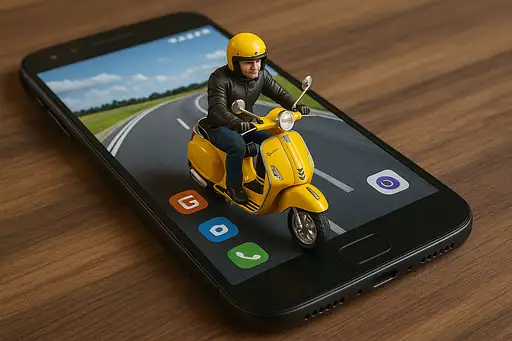
5 months ago

{ "scene": { "concept": "augmented reality / 3D illusion", "style": "photo-realistic with surreal element", "mood": "playful, imaginative", "perspective": "low angle, close-up view of smartphone" }, "foreground_object": { "type": "smartphone", "orientation": "lying flat on wooden surface", "screen_content": { "background": "curving highway road with landscape and sky", "apps": [ { "icon": "gallery", "position": "bottom left" }, { "icon": "camera", "position": "bottom center" }, { "icon": "phone", "position": "bottom right" } ] }, "3d_element": { "object": "miniature man on yellow Vespa scooter", "style": "realistic with cartoon scale", "position": "riding off the phone screen from background to foreground", "details": { "helmet": "yellow", "jacket": "black", "pants": "jeans", "scooter_brand": "Vespa", "interaction": "blends physical and digital — wheels overlap phone edge" } } }, "background_surface": { "material": "wood grain desk or tabletop", "texture": "smooth with visible grain patterns", "lighting": { "type": "soft diffused natural light", "direction": "top left", "shadows": "mild shadows under phone and scooter" } }, "camera": { "lens": "macro or short telephoto", "focus": "sharp on phone and 3D rider", "depth_of_field": "moderate (slight background blur)", "framing": "diagonal composition with phone angled across frame" }, "effects": { "blend_mode": "AR illusion / 3D pop-out", "emphasis": "depth trickery and motion realism", "color_grading": "natural saturation with a bright pop on yellow scooter" } }

1 month ago

Ultra-realistic cinematic concept art. A Moroccan man in his late 20s — clean-shaven, sharp jawline, medium taper fade with short buzz cut — sits powerfully on a brutalist throne made from cracked concrete, scorched books, rusted rebar, shattered satellite dishes, and melted tech debris. His gaze is direct, heavy, serious — full of rage, loss, and pride. His posture is grounded, kinglike, a man forged by betrayal, not crowned by privilege. He wears a modern Moroccan warrior-king outfit: a long charcoal-black trench coat made from military fabric, faded gold zellige embroidery lining the cuffs and edges. Beneath, a worn cracked bulletproof vest. His matte-black pants have rugged metal strap accents, and dusty combat boots show battlewear. Over his shoulder, a torn deep red cloak — like a fallen flag turned royal cape. A rusted metallic star medal is pinned to his chest. His fingers are covered with chipped steel rings — no shine, just scars. A fractured crown of gold and iron rests on his head — dented, sharp, powerful. Not ceremonial, but forged from ruin and defiance. It’s heavy, symbolic — a burden earned. Background: Ruined Moroccan cityscape — crumbling domes, broken concrete walls, twisted rebar, burnt-out cars, and collapsed towers. A half-burned Moroccan flag hangs in the back, fluttering from a broken wall. The sky is layered with storm clouds — ash grey, storm blue, deep purples. A golden-orange light pierces the clouds in the distance like hope. Ash particles drift in the foreground, cinematic. Typography: “Trône sur les Ruines” in large cracked metallic gold serif font — clean but weathered. Top left or bottom right. Regal, minimal, poetic. Color Palette: Coal black, ash grey, Moroccan red, storm blue, bronze gold, burnt orange, dusty beige. Mood: Royalty born from survival. Pain turned into power. Cinematic, violent, majestic, tragic. Style: Ultra-detailed, dramatic lighting, high contrast, hyper-realistic rendering. Poster-quality. Influenced by Yeezus, The Blueprint, LiveLoveA$AP, and French war photography. -- full body shot, cinematic composition, wide angle, throne fully visible, Moroccan flag visible in background, apocalyptic setting, dramatic shadows, golden light, storm clouds, ash drifting, rule of thirds framing

1 month ago

Album Cover for: “Trône sur les Ruines” Format: Wide shot, full body, cinematic environment, poster-quality Ultra-realistic cinematic concept art of a Moroccan man in his late 20s — light brown skin, clean-shaven, with a short buzz cut and medium taper fade — sitting proudly and powerfully on a massive brutalist throne. His body language is heavy and dominant: legs planted wide, elbows on knees, hands gripping the throne armrests. His eyes lock directly onto the viewer — serious, furious, proud. His expression carries the weight of survival and leadership born through chaos. He looks like a street king forged in war, not luxury. The throne is enormous, crafted from cracked concrete, twisted rebar, scorched books, shattered electronics, rusted weapons, and destroyed satellite parts — a symbolic fusion of revolution and ruin. It sits atop rubble and ash. Behind him, the destroyed skyline of a Moroccan city: burned buildings, collapsed domes, broken antennas, crumbling high-rises, graffiti-scarred walls. A torn Moroccan flag flutters in the distance, hanging from a bent metal pole. The man wears a modern warrior-royalty outfit: a long dark trench coat made from military fabric, lined with faded golden Moroccan embroidery (zellige patterns), a worn bulletproof vest underneath, armored combat pants with tactical straps, and black scratched leather boots. A tattered deep red cloak is thrown over one shoulder. On his chest, a bent metal star medal — not shiny, but earned. His crown is raw and symbolic: cracked gold fused with rusted iron, dented like it survived fire — resting slightly tilted on his head. The sky is cinematic: thick storm clouds rolling in, deep greys and purples, with one sharp beam of golden-orange light breaking through — hope after destruction. Ash and dust drift in the air, adding texture and motion. Typography: “Trône sur les Ruines” in cracked gold serif font, minimalist, sharp, placed bottom right or top left. Color palette: Ash grey, Moroccan red, coal black, bronze gold, burnt orange, storm blue. Mood: Powerful, apocalyptic, victorious. A portrait of survival and reclaimed legacy. Style: Cinematic, ultra-detailed, wide angle, poster-quality realism. Inspired by Yeezus, French war photojournalism, LiveLoveA$AP, and dystopian street rebellion aesthetics. — full body shot, wide angle, cinematic composition, Moroccan ruins in full view, background visible, throne fully visible, urban destruction, ash particles, crown visible, golden light from clouds, no blur, no fantasy, hyper-detailed, realistic lighting, gritty textures