A sample prompt of what you can find in this page
Prompt by Sxylla

acid lighting prompts

very few results

2 months ago

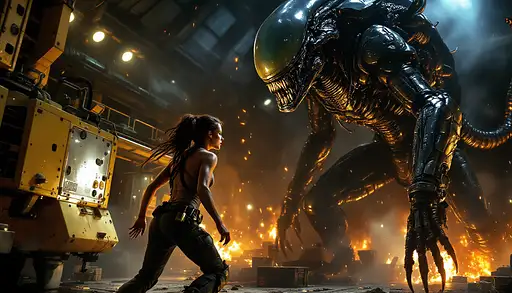
The climactic showdown aboard the USS Sulaco cargo bay—Ellen Ripley, clad in a scorched tank top and utility pants, pilots the towering yellow mechanized Power Loader exosuit, its hydraulic arms crackling with motion and raw industrial strength. Her expression is fierce, determined, sweat-streaked, lit by harsh overhead floodlights. She faces off against the towering Xenomorph Queen—massive, biomechanical, and nightmarishly elegant—its elongated skull glistening with slime, razor-sharp fangs bared in primal fury. The Power Loader’s clawed pincers are locked with the Queen’s snapping jaws and thrashing tail, each trying to overpower the other in a deadly clash of steel and sinew. Sparks fly as metal grinds against chitinous armor. The floor beneath them is scorched and pocked from acid burns and previous battles, littered with industrial crates, broken machinery, and flickering warning lights. Fog and steam hiss from broken pipes, while red hazard strobes pulse across the scene, casting dramatic shadows and eerie glows. Behind them, the open airlock looms—its bright void a deadly drop into space. Ripley fights not just for survival, but to protect what remains of humanity. The atmosphere is thick with tension and adrenaline—sci-fi horror at its most intense. Rendered in a brutal, high-contrast, deeply expressive digital painting style—dark tones, unholy highlights, cinematic framing, and emotionally profound energy. Every detail should scream final battle, heroic defiance, and monstrous wrath. Epic final battle, cinematic sci-fi horror, intense drama, brutal composition, industrial sci-fi, high tension, expressionist lighting, fierce heroine, nightmare creature design, Ridley Scott inspiration, 16:9 wide aspect ratio, high detail, emotional depth, high contrast lighting, masterpiece.

2 months ago

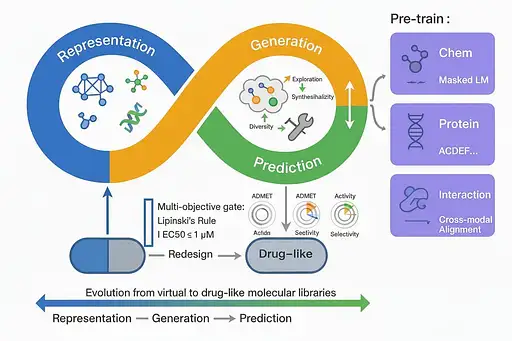
Scientific infographic illustrating an AI-driven closed-loop framework for virtual molecular library construction, showing the adaptive cycle of “Representation – Generation – Prediction – Feedback”. Central theme: artificial intelligence empowering drug discovery and molecular design. The diagram is a circular workflow structure centered on the AI virtual molecular library system. Left module: Representation Learning, visualized with neural network icons, molecular graphs, protein structures, and amino acid sequence symbols, representing molecular and protein feature embeddings. Upper-right module: Molecular Generation, showing diffusion or VAE-like model generating diverse small molecules, arrows indicating exploration of chemical space, novelty, and synthesizability constraints. Lower-right module: Property Prediction, containing ADMET, activity, and selectivity metrics represented by radar charts or data panels, feeding results back to the representation module to close the loop. Bottom section: Evolution from virtual to drug-like molecular libraries, shown as a smooth gradient arrow with multi-objective optimization icons balancing drug-likeness and diversity. Right-side branch: Pretrained models for new target ligand design, divided into three submodules—small molecule pretraining, protein pretraining, and cross-modal pretraining (protein–ligand interaction)—depicting embedding fusion or contrastive learning in shared latent space. No human figures, only abstract scientific symbols and molecular visuals. Style: flat vector scientific infographic, modern and minimalistic, clear logical flow, smooth connections between modules. Color scheme: blue for AI and representation, orange-yellow for generation, green for prediction; background light gray or white. Typography: clean sans-serif labels, concise annotations. High resolution (≥600 dpi), suitable for journal publication, ultra-clear, balanced layout, professional academic tone.