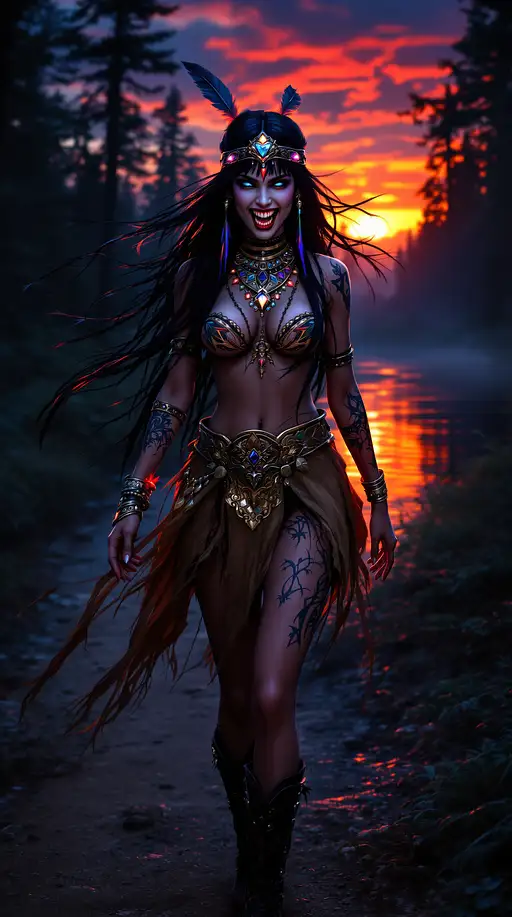
A sample prompt of what you can find in this page
Prompt by 8d96dfd5c78

color banding prompts

very few results

8 months ago

Using the attached image, regenerate an image in the same style as this one. But with the following description: You need to draw a mille-fleurs tapestry of The Lady and the Unicorn, woven after 1515 but destroyed in Boussac in 1845. George Sand gives a rather brief description. "The lady is seated on a very rich throne. She wears a sort of royal turban on her forehead. There is something Asian in the ornaments of her finery and the canopy above her." So we will have a lion on the left and a unicorn on the right. Be as precise as possible and use the setting and colors of the attached piece. You need two different trees: an oak and an orange tree. The wooden throne must be wide, with a backrest that stops at the lady's shoulders. The figurines of a small lion and a small unicorn are carved on the top of the throne's uprights. The drooping tips of the canopy should not be visible, hidden by the lion and the unicorn. The lady's head is turned towards the unicorn; her turban should not be too large. The lion should be the same size as the unicorn. He should be on the left, with all four paws on the ground, standing upright and proud. He has a plumed tail. He is looking to his left (not looking at us). He is sitting on his haunches. He is holding the pole of the oriflamme-style flag, with a red background and a blue diagonal band rising to the left, bearing three rising white crescent moons, as in the attached image. The trunk of the tree on the left should not be behind his head. The unicorn is white. He is proudly raising his head. His four paws are on the ground. He is sitting on his haunches. He is looking at the lady. Thank you.

7 months ago

Create a meticulously staged cinematic scene with rigid symmetry and frontal, low-angle framing, emphasizing a diagonal composition (45-degree tilt) where all elements align along a single dynamic axis. Color Grading: 60% Dominant: Soft, powdery pastel pinks (Pantone 12-1109 TPX "Marshmallow") saturating the sky, snow, and TV casing. 30% Secondary: Frosted teal blues (HEX #6ECEDA) in the glacial lake, aurora, and TV screen static. 10% Accent: Mustard-yellow (Pantone 15-0950 TPX "Golden Glow") in the aurora streaks, wool tufts, and corroded metal knobs. TV Design: A 1950s Bakelite TV (matte eggshell plastic with hairline cracks) tilted diagonally (top-left corner at 10 o’clock, bottom-right submerged at 4 o’clock). Crack: A jagged diagonal fissure (2cm wide) splits the screen from top-left to bottom-right, leaking viscous, neon-bright color bar pigment (RGB values: pink #FF9EB5, teal #5FDAC3, gold #FFD700) that pools into the water below. Materials: Body: Faux-weathered plastic with chipped edges revealing rusted steel underlayers. Details: Three rotary knobs (tarnished brass, 4cm diameter) labeled "VOL," "TUNE," "POWER." Cables: Braided wool cords (undyed cream yarn, 3cm thickness) coiled around the TV’s base, fraying at the ends. Screen Imagery: Static Overlay: A 1953 RCA-style color bar test pattern (8 vertical bands) glitching every 2 seconds, causing the teal and pink bars to "melt" downward into liquid the word "Imagen-4" glitches on the screen Underlying Image: A faint, glowing topographical map (golden-yellow lines on indigo) dissolves into water that cascades from the screen’s crack, merging with the glacial lake. Environment: Glacial Lake: Semi-frozen water (translucent teal, 70% opacity) with jagged ice shards (20cm height) encircling the TV. Snowfall: Heavy, dense snowflakes (1cm diameter) falling at 45 degrees, accumulating on the TV’s top-left corner. Aurora Borealis: Three parallel bands (pink #FFB3D1, teal #7FE5E5, gold #FFE44D) in smooth sine waves, 15° tilt, 80% opacity. Sky: Ultra-high-contrast starfield (ISO 51200 noise pattern) with 2,000 visible stars (randomized 2-4px white dots). Lighting & Effects: Key Light: A frontal, low-orange sodium vapor lamp (3200K) casting sharp diagonal shadows (20° angle) from the TV onto the ice. Bloom: Halation around the aurora and screen, radius 15px, intensity 70%. Textures: Film Grain: 35mm Kodak Vision3 250D overlay (gritty, high-detail). Lens Defects: Two hairline scratches (1px width) at 15° and 75° angles, plus hexagonal lens flare (60% opacity) from the aurora. Physics & Motion: Water: Viscous fluid dynamics—the leaking color bars swirl in 5cm eddies, blending with the glacial lake. Wool: Submerged yarn floats upward in 10cm tufts, swaying at 0.5Hz frequency. Result: A hyper-detailed, reference-free scene that implicitly channels Wes Anderson’s aesthetic through obsessive symmetry, retro-kitsch materials, and a strict 60/30/10 pastel hierarchy—no director named, all style embedded in granular technical specs.


7 months ago

"Create a meticulously staged cinematic scene with rigid symmetry and frontal, low-angle framing, emphasizing a diagonal composition (45-degree tilt) where all elements align along a single dynamic axis. Color Grading: 60% Dominant: Soft, powdery pastel pinks (Pantone 12-1109 TPX "Marshmallow") saturating the sky, snow, and TV casing. 30% Secondary: Frosted teal blues (HEX #6ECEDA) in the glacial lake, aurora, and TV screen static. 10% Accent: Mustard-yellow (Pantone 15-0950 TPX "Golden Glow") in the aurora streaks, wool tufts, and corroded metal knobs. TV Design: A 1950s Bakelite TV (matte eggshell plastic with hairline cracks) tilted diagonally (top-left corner at 10 o’clock, bottom-right submerged at 4 o’clock). Crack: A jagged diagonal fissure (2cm wide) splits the screen from top-left to bottom-right, leaking viscous, neon-bright color bar pigment (RGB values: pink #FF9EB5, teal #5FDAC3, gold #FFD700) that pools into the water below. Materials: Body: Faux-weathered plastic with chipped edges revealing rusted steel underlayers. Details: Three rotary knobs (tarnished brass, 4cm diameter) labeled "VOL," "TUNE," "POWER." Cables: Braided wool cords (undyed cream yarn, 3cm thickness) coiled around the TV’s base, fraying at the ends. Screen Imagery: Static Overlay: A 1953 RCA-style color bar test pattern (8 vertical bands) glitching every 2 seconds, causing the teal and pink bars to "melt" downward into liquid with the word "Prompthero" barely visible on it. Underlying Image: A faint, glowing topographical map (golden-yellow lines on indigo) dissolves into water that cascades from the screen’s crack, merging with the glacial lake. Environment: Glacial Lake: Semi-frozen water (translucent teal, 70% opacity) with jagged ice shards (20cm height) encircling the TV. Snowfall: Heavy, dense snowflakes (1cm diameter) falling at 45 degrees, accumulating on the TV’s top-left corner. Aurora Borealis: Three parallel bands (pink #FFB3D1, teal #7FE5E5, gold #FFE44D) in smooth sine waves, 15° tilt, 80% opacity. Sky: Ultra-high-contrast starfield (ISO 51200 noise pattern) with 2,000 visible stars (randomized 2-4px white dots). Lighting & Effects: Key Light: A frontal, low-orange sodium vapor lamp (3200K) casting sharp diagonal shadows (20° angle) from the TV onto the ice. Bloom: Halation around the aurora and screen, radius 15px, intensity 70%. Textures: Film Grain: 35mm Kodak Vision3 250D overlay (gritty, high-detail). Lens Defects: Two hairline scratches (1px width) at 15° and 75° angles, plus hexagonal lens flare (60% opacity) from the aurora. Physics & Motion: Water: Viscous fluid dynamics—the leaking color bars swirl in 5cm eddies, blending with the glacial lake. Wool: Submerged yarn floats upward in 10cm tufts, swaying at 0.5Hz frequency. Result: A hyper-detailed, reference-free scene that implicitly channels Wes Anderson’s aesthetic through obsessive symmetry, retro-kitsch materials, and a strict 60/30/10 pastel hierarchy—no director named, all style embedded in granular technical specs.