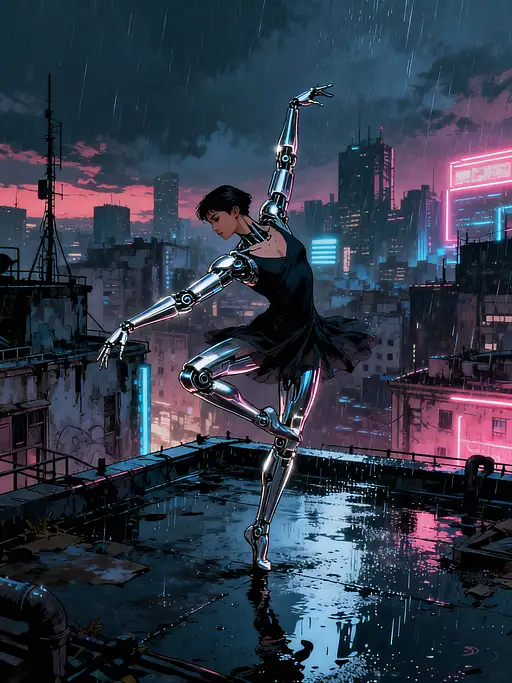
A sample prompt of what you can find in this page
Prompt by ElectricL

gritty aesthetic prompts

very few results

4 months ago

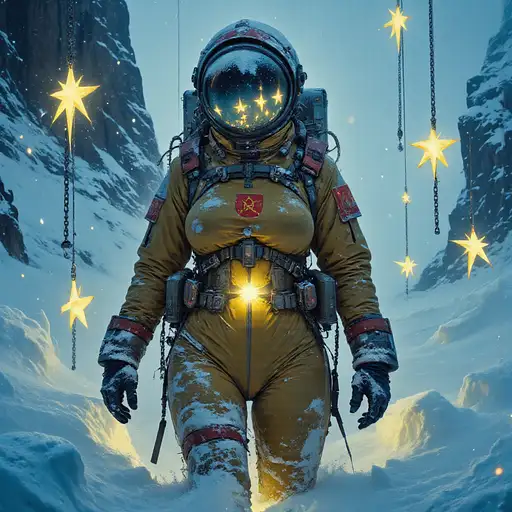
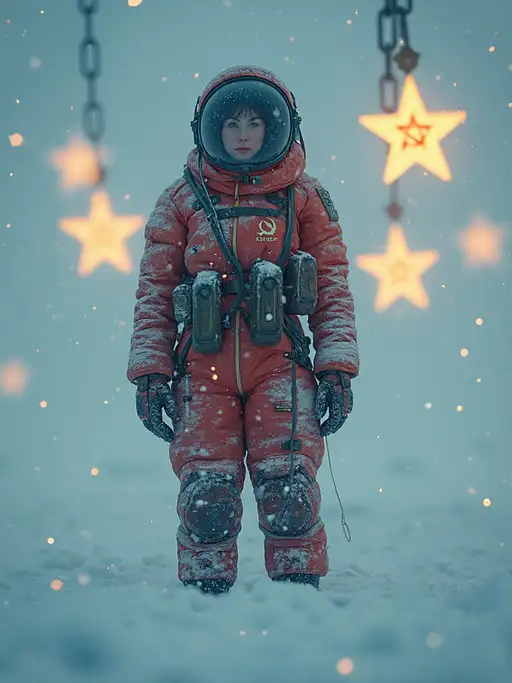
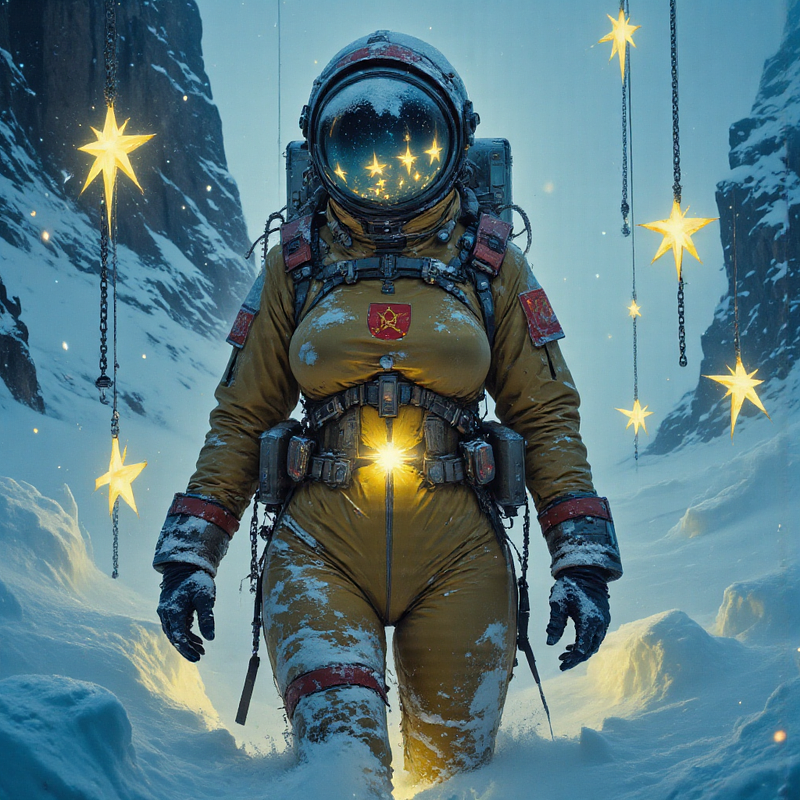
(A hyper-realistic, masterpiece-level color photograph:1.3) of a woman in a Soviet-style retrofuturistic spacesuit (Soviet retrofuturism:1.5) standing in the icy expanse of the Arctic during a fierce blizzard (blizzard in the Arctic:1.4). The woman’s suit, weathered and bulky, bears the clear red insignia of CCCP across the chest (CCCP insignia:1.5), adding to the harsh, militaristic aesthetic of the scene. The spacesuit has a Cold War-era design, with bold red accents and a heavy, utilitarian build, blending the futuristic with the gritty, industrial style of the Soviet Union. Surrounding her, several small, glowing stars float tethered by thick industrial chains (tethered glowing stars in a blizzard:1.4). These stars cut through the blizzard, casting yellow light that glows eerily against the swirling snow. The stars, connected to the icy ground by chains, sway violently in the wind, their light creating dynamic volumetric beams as they fight against the storm. The woman’s helmet visor reflects the glowing stars and the chaos of the blizzard around her, casting intricate patterns of light across her suit, which is half-covered in snow and ice. The volumetric lighting from the stars pierces the thick snowstorm, illuminating the drifting snowflakes and casting long, dramatic shadows across the snowy landscape. The environment is harsh and unforgiving—her spacesuit is covered in frost, and the cold, biting wind whips at her, while snow drifts build up around her legs. The blizzard creates an intense sense of motion, with the snow swirling around in unpredictable patterns, making it feel as though the woman is standing in the heart of a Soviet Arctic research mission gone wrong. Amidst the storm, the CCCP insignia glows faintly under the light of the stars, a symbol of the lost Soviet expedition. The glowing stars and industrial chains are tethered to the icy ground, creating a surreal, otherworldly scene in the middle of this brutal landscape. The scene is a combination of retrofuturistic design and gritty realism, with the harshness of the blizzard contrasting against the surreal glow of the stars. The intense lighting from the stars and the complex shadows they cast against the swirling snow create a dramatic, cinematic atmosphere. The overall mood is cold, brutal, and haunting, capturing a moment of isolation and survival in the Soviet retrofuturistic Arctic wasteland

2 months ago

A ultra realistic photo of a girl standing next to a Rolls-Royce, Her eyes are bright, cool blue with a hint of grey, slightly almond-shaped with thick naturally curled lashes and softly defined brows. Her nose is delicate and narrow with a softly rounded tip, clearly adorned with a small silver nose-ring piercing on the left nostril, catching a subtle metallic reflection. Her lips are full and softly textured in warm rose-brown. Deep brunette hair in long natural waves with curtain bangs and a few realistic flyaways. Warm sun-kissed bronze skin with fine freckles across cheeks and nose; visible pores and micro-texture in natural light. with old egyptian buildings in the background. Shot as if on a disposable Fujifilm camera with an 8mm fisheye lens; Portra 400 + Cinestill 800 film aesthetic; heavy grain, dusty frame, slight film imperfections, direct flash. Vogue fashion editorial vibe, gritty film photography style, dark cinematic tones, ultra-realistic textures, glossy reflections, and photo-realism. Moisture-reactive and snug fabric physics, natural fabric tension with contour shaping, subtle highlights on folds and curves with midtones matte for realism, gravity-aware and maximally opulent décolleté effect, ultra-voluminous neckline shaping, celebrity-style glamour, influencer aesthetics with refined, full silhouette, subtle moisture-adaptive skin sheen with natural specular highlights, visible pores, soft skin texture, faint vein detailing for hyperrealism.

6 months ago

Create a meticulously staged cinematic scene with rigid symmetry and frontal, low-angle framing, emphasizing a diagonal composition (45-degree tilt) where all elements align along a single dynamic axis. Color Grading: 60% Dominant: Soft, powdery pastel pinks (Pantone 12-1109 TPX "Marshmallow") saturating the sky, snow, and TV casing. 30% Secondary: Frosted teal blues (HEX #6ECEDA) in the glacial lake, aurora, and TV screen static. 10% Accent: Mustard-yellow (Pantone 15-0950 TPX "Golden Glow") in the aurora streaks, wool tufts, and corroded metal knobs. TV Design: A 1950s Bakelite TV (matte eggshell plastic with hairline cracks) tilted diagonally (top-left corner at 10 o’clock, bottom-right submerged at 4 o’clock). Crack: A jagged diagonal fissure (2cm wide) splits the screen from top-left to bottom-right, leaking viscous, neon-bright color bar pigment (RGB values: pink #FF9EB5, teal #5FDAC3, gold #FFD700) that pools into the water below. Materials: Body: Faux-weathered plastic with chipped edges revealing rusted steel underlayers. Details: Three rotary knobs (tarnished brass, 4cm diameter) labeled "VOL," "TUNE," "POWER." Cables: Braided wool cords (undyed cream yarn, 3cm thickness) coiled around the TV’s base, fraying at the ends. Screen Imagery: Static Overlay: A 1953 RCA-style color bar test pattern (8 vertical bands) glitching every 2 seconds, causing the teal and pink bars to "melt" downward into liquid the word "Imagen-4" glitches on the screen Underlying Image: A faint, glowing topographical map (golden-yellow lines on indigo) dissolves into water that cascades from the screen’s crack, merging with the glacial lake. Environment: Glacial Lake: Semi-frozen water (translucent teal, 70% opacity) with jagged ice shards (20cm height) encircling the TV. Snowfall: Heavy, dense snowflakes (1cm diameter) falling at 45 degrees, accumulating on the TV’s top-left corner. Aurora Borealis: Three parallel bands (pink #FFB3D1, teal #7FE5E5, gold #FFE44D) in smooth sine waves, 15° tilt, 80% opacity. Sky: Ultra-high-contrast starfield (ISO 51200 noise pattern) with 2,000 visible stars (randomized 2-4px white dots). Lighting & Effects: Key Light: A frontal, low-orange sodium vapor lamp (3200K) casting sharp diagonal shadows (20° angle) from the TV onto the ice. Bloom: Halation around the aurora and screen, radius 15px, intensity 70%. Textures: Film Grain: 35mm Kodak Vision3 250D overlay (gritty, high-detail). Lens Defects: Two hairline scratches (1px width) at 15° and 75° angles, plus hexagonal lens flare (60% opacity) from the aurora. Physics & Motion: Water: Viscous fluid dynamics—the leaking color bars swirl in 5cm eddies, blending with the glacial lake. Wool: Submerged yarn floats upward in 10cm tufts, swaying at 0.5Hz frequency. Result: A hyper-detailed, reference-free scene that implicitly channels Wes Anderson’s aesthetic through obsessive symmetry, retro-kitsch materials, and a strict 60/30/10 pastel hierarchy—no director named, all style embedded in granular technical specs.
7 months ago

"Create a meticulously staged cinematic scene with rigid symmetry and frontal, low-angle framing, emphasizing a diagonal composition (45-degree tilt) where all elements align along a single dynamic axis. Color Grading: 60% Dominant: Soft, powdery pastel pinks (Pantone 12-1109 TPX "Marshmallow") saturating the sky, snow, and TV casing. 30% Secondary: Frosted teal blues (HEX #6ECEDA) in the glacial lake, aurora, and TV screen static. 10% Accent: Mustard-yellow (Pantone 15-0950 TPX "Golden Glow") in the aurora streaks, wool tufts, and corroded metal knobs. TV Design: A 1950s Bakelite TV (matte eggshell plastic with hairline cracks) tilted diagonally (top-left corner at 10 o’clock, bottom-right submerged at 4 o’clock). Crack: A jagged diagonal fissure (2cm wide) splits the screen from top-left to bottom-right, leaking viscous, neon-bright color bar pigment (RGB values: pink #FF9EB5, teal #5FDAC3, gold #FFD700) that pools into the water below. Materials: Body: Faux-weathered plastic with chipped edges revealing rusted steel underlayers. Details: Three rotary knobs (tarnished brass, 4cm diameter) labeled "VOL," "TUNE," "POWER." Cables: Braided wool cords (undyed cream yarn, 3cm thickness) coiled around the TV’s base, fraying at the ends. Screen Imagery: Static Overlay: A 1953 RCA-style color bar test pattern (8 vertical bands) glitching every 2 seconds, causing the teal and pink bars to "melt" downward into liquid with the word "Prompthero" barely visible on it. Underlying Image: A faint, glowing topographical map (golden-yellow lines on indigo) dissolves into water that cascades from the screen’s crack, merging with the glacial lake. Environment: Glacial Lake: Semi-frozen water (translucent teal, 70% opacity) with jagged ice shards (20cm height) encircling the TV. Snowfall: Heavy, dense snowflakes (1cm diameter) falling at 45 degrees, accumulating on the TV’s top-left corner. Aurora Borealis: Three parallel bands (pink #FFB3D1, teal #7FE5E5, gold #FFE44D) in smooth sine waves, 15° tilt, 80% opacity. Sky: Ultra-high-contrast starfield (ISO 51200 noise pattern) with 2,000 visible stars (randomized 2-4px white dots). Lighting & Effects: Key Light: A frontal, low-orange sodium vapor lamp (3200K) casting sharp diagonal shadows (20° angle) from the TV onto the ice. Bloom: Halation around the aurora and screen, radius 15px, intensity 70%. Textures: Film Grain: 35mm Kodak Vision3 250D overlay (gritty, high-detail). Lens Defects: Two hairline scratches (1px width) at 15° and 75° angles, plus hexagonal lens flare (60% opacity) from the aurora. Physics & Motion: Water: Viscous fluid dynamics—the leaking color bars swirl in 5cm eddies, blending with the glacial lake. Wool: Submerged yarn floats upward in 10cm tufts, swaying at 0.5Hz frequency. Result: A hyper-detailed, reference-free scene that implicitly channels Wes Anderson’s aesthetic through obsessive symmetry, retro-kitsch materials, and a strict 60/30/10 pastel hierarchy—no director named, all style embedded in granular technical specs.

4 months ago

(A hyper-realistic, masterpiece-level color photograph:1.3) of a woman in a Soviet-style retrofuturistic spacesuit (Soviet retrofuturism:1.5) standing in the icy expanse of the Arctic during a fierce blizzard (blizzard in the Arctic:1.4). The woman’s suit, weathered and bulky, bears the clear red insignia of CCCP across the chest (CCCP insignia:1.5), adding to the harsh, militaristic aesthetic of the scene. The spacesuit has a Cold War-era design, with bold red accents and a heavy, utilitarian build, blending the futuristic with the gritty, industrial style of the Soviet Union. Surrounding her, several small, glowing stars float tethered by thick industrial chains (tethered glowing stars in a blizzard:1.4). These stars cut through the blizzard, casting yellow light that glows eerily against the swirling snow. The stars, connected to the icy ground by chains, sway violently in the wind, their light creating dynamic volumetric beams as they fight against the storm. The woman’s helmet visor reflects the glowing stars and the chaos of the blizzard around her, casting intricate patterns of light across her suit, which is half-covered in snow and ice. The volumetric lighting from the stars pierces the thick snowstorm, illuminating the drifting snowflakes and casting long, dramatic shadows across the snowy landscape. The environment is harsh and unforgiving—her spacesuit is covered in frost, and the cold, biting wind whips at her, while snow drifts build up around her legs. The blizzard creates an intense sense of motion, with the snow swirling around in unpredictable patterns, making it feel as though the woman is standing in the heart of a Soviet Arctic research mission gone wrong. Amidst the storm, the CCCP insignia glows faintly under the light of the stars, a symbol of the lost Soviet expedition. The glowing stars and industrial chains are tethered to the icy ground, creating a surreal, otherworldly scene in the middle of this brutal landscape. The scene is a combination of retrofuturistic design and gritty realism, with the harshness of the blizzard contrasting against the surreal glow of the stars. The intense lighting from the stars and the complex shadows they cast against the swirling snow create a dramatic, cinematic atmosphere. The overall mood is cold, brutal, and haunting, capturing a moment of isolation and survival in the Soviet retrofuturistic Arctic wasteland