A sample prompt of what you can find in this page
Prompt by Chorlo

jagged and weathered prompts

very few results

7 months ago

Create a meticulously staged cinematic scene with rigid symmetry and frontal, low-angle framing, emphasizing a diagonal composition (45-degree tilt) where all elements align along a single dynamic axis. Color Grading: 60% Dominant: Soft, powdery pastel pinks (Pantone 12-1109 TPX "Marshmallow") saturating the sky, snow, and TV casing. 30% Secondary: Frosted teal blues (HEX #6ECEDA) in the glacial lake, aurora, and TV screen static. 10% Accent: Mustard-yellow (Pantone 15-0950 TPX "Golden Glow") in the aurora streaks, wool tufts, and corroded metal knobs. TV Design: A 1950s Bakelite TV (matte eggshell plastic with hairline cracks) tilted diagonally (top-left corner at 10 o’clock, bottom-right submerged at 4 o’clock). Crack: A jagged diagonal fissure (2cm wide) splits the screen from top-left to bottom-right, leaking viscous, neon-bright color bar pigment (RGB values: pink #FF9EB5, teal #5FDAC3, gold #FFD700) that pools into the water below. Materials: Body: Faux-weathered plastic with chipped edges revealing rusted steel underlayers. Details: Three rotary knobs (tarnished brass, 4cm diameter) labeled "VOL," "TUNE," "POWER." Cables: Braided wool cords (undyed cream yarn, 3cm thickness) coiled around the TV’s base, fraying at the ends. Screen Imagery: Static Overlay: A 1953 RCA-style color bar test pattern (8 vertical bands) glitching every 2 seconds, causing the teal and pink bars to "melt" downward into liquid the word "Imagen-4" glitches on the screen Underlying Image: A faint, glowing topographical map (golden-yellow lines on indigo) dissolves into water that cascades from the screen’s crack, merging with the glacial lake. Environment: Glacial Lake: Semi-frozen water (translucent teal, 70% opacity) with jagged ice shards (20cm height) encircling the TV. Snowfall: Heavy, dense snowflakes (1cm diameter) falling at 45 degrees, accumulating on the TV’s top-left corner. Aurora Borealis: Three parallel bands (pink #FFB3D1, teal #7FE5E5, gold #FFE44D) in smooth sine waves, 15° tilt, 80% opacity. Sky: Ultra-high-contrast starfield (ISO 51200 noise pattern) with 2,000 visible stars (randomized 2-4px white dots). Lighting & Effects: Key Light: A frontal, low-orange sodium vapor lamp (3200K) casting sharp diagonal shadows (20° angle) from the TV onto the ice. Bloom: Halation around the aurora and screen, radius 15px, intensity 70%. Textures: Film Grain: 35mm Kodak Vision3 250D overlay (gritty, high-detail). Lens Defects: Two hairline scratches (1px width) at 15° and 75° angles, plus hexagonal lens flare (60% opacity) from the aurora. Physics & Motion: Water: Viscous fluid dynamics—the leaking color bars swirl in 5cm eddies, blending with the glacial lake. Wool: Submerged yarn floats upward in 10cm tufts, swaying at 0.5Hz frequency. Result: A hyper-detailed, reference-free scene that implicitly channels Wes Anderson’s aesthetic through obsessive symmetry, retro-kitsch materials, and a strict 60/30/10 pastel hierarchy—no director named, all style embedded in granular technical specs.

7 months ago

"Create a meticulously staged cinematic scene with rigid symmetry and frontal, low-angle framing, emphasizing a diagonal composition (45-degree tilt) where all elements align along a single dynamic axis. Color Grading: 60% Dominant: Soft, powdery pastel pinks (Pantone 12-1109 TPX "Marshmallow") saturating the sky, snow, and TV casing. 30% Secondary: Frosted teal blues (HEX #6ECEDA) in the glacial lake, aurora, and TV screen static. 10% Accent: Mustard-yellow (Pantone 15-0950 TPX "Golden Glow") in the aurora streaks, wool tufts, and corroded metal knobs. TV Design: A 1950s Bakelite TV (matte eggshell plastic with hairline cracks) tilted diagonally (top-left corner at 10 o’clock, bottom-right submerged at 4 o’clock). Crack: A jagged diagonal fissure (2cm wide) splits the screen from top-left to bottom-right, leaking viscous, neon-bright color bar pigment (RGB values: pink #FF9EB5, teal #5FDAC3, gold #FFD700) that pools into the water below. Materials: Body: Faux-weathered plastic with chipped edges revealing rusted steel underlayers. Details: Three rotary knobs (tarnished brass, 4cm diameter) labeled "VOL," "TUNE," "POWER." Cables: Braided wool cords (undyed cream yarn, 3cm thickness) coiled around the TV’s base, fraying at the ends. Screen Imagery: Static Overlay: A 1953 RCA-style color bar test pattern (8 vertical bands) glitching every 2 seconds, causing the teal and pink bars to "melt" downward into liquid with the word "Prompthero" barely visible on it. Underlying Image: A faint, glowing topographical map (golden-yellow lines on indigo) dissolves into water that cascades from the screen’s crack, merging with the glacial lake. Environment: Glacial Lake: Semi-frozen water (translucent teal, 70% opacity) with jagged ice shards (20cm height) encircling the TV. Snowfall: Heavy, dense snowflakes (1cm diameter) falling at 45 degrees, accumulating on the TV’s top-left corner. Aurora Borealis: Three parallel bands (pink #FFB3D1, teal #7FE5E5, gold #FFE44D) in smooth sine waves, 15° tilt, 80% opacity. Sky: Ultra-high-contrast starfield (ISO 51200 noise pattern) with 2,000 visible stars (randomized 2-4px white dots). Lighting & Effects: Key Light: A frontal, low-orange sodium vapor lamp (3200K) casting sharp diagonal shadows (20° angle) from the TV onto the ice. Bloom: Halation around the aurora and screen, radius 15px, intensity 70%. Textures: Film Grain: 35mm Kodak Vision3 250D overlay (gritty, high-detail). Lens Defects: Two hairline scratches (1px width) at 15° and 75° angles, plus hexagonal lens flare (60% opacity) from the aurora. Physics & Motion: Water: Viscous fluid dynamics—the leaking color bars swirl in 5cm eddies, blending with the glacial lake. Wool: Submerged yarn floats upward in 10cm tufts, swaying at 0.5Hz frequency. Result: A hyper-detailed, reference-free scene that implicitly channels Wes Anderson’s aesthetic through obsessive symmetry, retro-kitsch materials, and a strict 60/30/10 pastel hierarchy—no director named, all style embedded in granular technical specs.

9 months ago

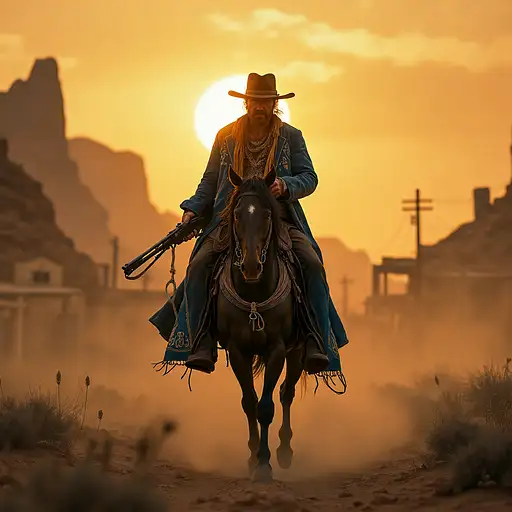
(Spaghetti Western meets Hindu Mythology, Cinematic, Gritty, Mythic Americana, Clint Eastwood's Unforgiven-style storytelling, Hyperreal, Dust and Gunpowder, Sunset Over the Frontier) (Gritty Cinematic Western:1.8, Hindu Mythology Meets Old West:2.0, Dust & Heat Haze:1.6, Sunburnt Leather & Weathered Cloth:1.5, Volumetric Light Through Dust:1.4, Classic Spaghetti Western Composition:1.8) The frontier is vast, endless. The sun hangs low and swollen, a burning red eye sinking behind the jagged silhouette of the mountains, bleeding golden light across the dust-choked sky. A lone rider moves through the haze, his dark stallion kicking up a slow trail of dust, the sound of hooves muffled by the dry, cracked earth. Vishnu, the Divine Gunslinger, moves like a ghost through this godforsaken land, his presence a whisper on the wind, a warning before the storm. He is adorned in a weathered duster, its deep blue fabric threadbare yet regal, embroidered in golden Sanskrit that shifts and shimmers under the dying light. Beneath it, his celestial skin glows faintly, a blue so deep it seems carved from the twilight sky itself. His golden eyes burn like twin desert suns, reflecting the fire of the West, the violence of the frontier, the weight of justice balanced on the edge of a blade. From beneath his coat, his four arms rest with an unnatural stillness, each poised for retribution. One hand grips the Sudarshana Revolver, an ancient pistol forged from the molten core of a dying star, its barrel etched with the shifting symbols of the cosmos. Another holds a coiled lasso woven from the threads of fate, glowing with the light of constellations long dead. The third hand remains open, palm outward—a warning, or perhaps a blessing. The fourth clutches the eternal lotus, a reminder that even in this land of dust and death, something divine lingers. Behind him, the town of Black Hollow waits, a rotting wooden carcass of a town, its saloon doors swaying in the wind, the church bell rusted and long silent. Shadows move behind glassless windows, fear tightening in the chests of men who know their reckoning has come. The outlaws of this place have no gods, no law but steel and blood, and yet even they whisper his name. The wind shifts, carrying the scent of gunpowder and sagebrush, and in the distance, a gang of riders appear on the ridge, silhouetted against the sun. Their leader spits, grips his rifle, and laughs. "Ain't no man gets to play god out here," he sneers. The six-shooter spins once, slow, deliberate. A single breath. A moment stretched between eternity and the dust. Vishnu narrows his golden gaze beneath the wide brim of his hat. He speaks only once. "God don’t play, friend." Then the world moves like lightning, like judgment, like fate itself unfurling.

4 months ago

A dark, decayed factory steeped in dampness and neglect. Rows of broken, lifeless androids hang from chains and diagnostic cables, their battered forms suspended like relics of a forgotten era. Each android faces forward, their heads slumped and limbs dangling limply, as if gravity alone holds them in place. The androids are diverse—some humanoid with slender frames and fragmented synthetic skin, others industrial with exposed hydraulics, rusted plating, and shattered components. Many are missing limbs, their wires and cables hanging loosely, sparking faintly in the oppressive gloom. Among the rows, two androids stand out—their hands intertwined in a final act of connection before their power cells died. One is humanoid, its delicate features cracked and weathered, its synthetic skin peeling to reveal intricate, rusting frameworks. The other is industrial, bulkier, with heavier plating and exposed joints, its arm barely holding on by a tangle of wires. Their clasped hands emit a faint glow, flickering like dying embers, the last remnant of their shared existence. The factory is drenched in atmosphere. Thick haze and mist cling to every surface, illuminated by the weak, flickering glow of malfunctioning CRT screens and sparking cables. Dim red light spills from a cracked overhead lamp, casting diffuse shadows across the room. A faint, rhythmic drip echoes through the cavernous space, the sound amplified by the oppressive silence. A flickering sign above the rows reads: “ANDROID MULTI-PURPOSE FOUNDRY.” The foundry walls are lined with rusted, obsolete machinery and control panels. Pools of stagnant water collect on the floor, reflecting the faint, scattered light in jagged, broken patterns. Dust and smoke swirl in the air, cutting through the faint godrays that streak through shattered skylights, further obscured by the thick haze. The shadows of dangling chains and lifeless androids create eerie silhouettes on the mist-covered walls. The atmosphere is suffocatingly gritty, a testament to the decay of innovation. The androids stand as silent witnesses to a bygone era, their shattered forms a chilling reflection of the hubris and failure of their creators. The two holding hands, surrounded by rows of decaying machines, remain a quiet, haunting symbol of connection amidst the ruin.